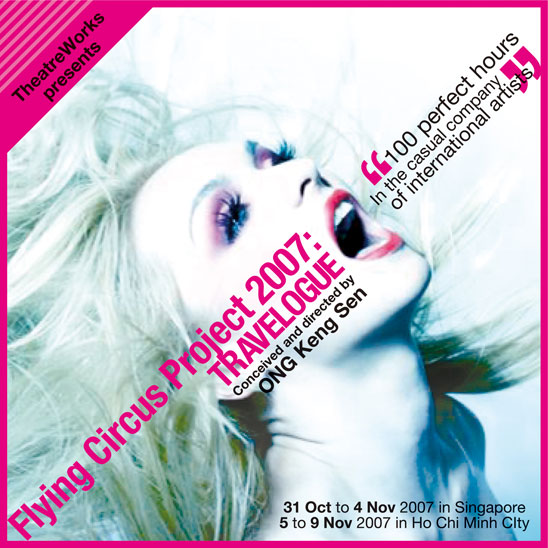
Wednesday, November 4, 2009

Tuesday, November 27, 2007
Late Interview with Melati Suryodarmo-Lutz
YS: What’s your favourite animal?
Melati: Dog. No, horse.
YS: How old were you when you first rode a horse?
Melati: 20.
YS: Was that in Indonesia or Germany?
Melati: Indonesia. I learned to ride. But then I fell and I had this terrible accident. I was in hospital (gestures towards face). When I was in Germany, 12 years later, I started to ride. But I don’t like German horses. I don’t like German horse people. The girls…
YS: Your performance in Ho Chi Minh City, with long hair, holding the liver – it reminded me a lot of Frida Kahlo’s surrealist work. Was that an influence?
Melati: I’m influenced by traditional spiritualism, which maybe if you put it into modern contexts it looks like surrealism.
YS: Tell me more about your practice.
Melati: Um. In what sense?
YS: Well, I know your training was in classical Indonesian dance -
Melati: When I was a child I was trained in Javanese dance like every other thousand Javanese kids. Going to the dance course, and I’m used to going on the stage because of that. And then also my parents sent me for taichi training and Vipassan meditation, and then I joined a theatre when I was in university, but that’s not so important.
And then I studied art in 1994. I started with performance art, but with a butoh dance choreographer. Anzu Furukawa. She was my professor. In Germany you have to have one professor to study with. And then after that I practiced more visual art based performance art with Marina Abramovic.
Yeah, I actually very interested in art. My body function. As a container. A sensor. Memories. And environment. Surrounds my body all environments. Sorry for my English; I’m just beyond my vocabulary to talk.
And I was, uh, interested to make my position as a human being in its organic system. It detaches like a politic-social-cultural-spiritual aspects. But for example, I would talk about politics. Of those other aspects in I have no direct experience. It’s not five minutes longer than it’s not five minutes. Just open my website, there are texts about my work and, uh, I did not write it. Someone else wrote (breaks out laughing) I appreciate. I just did not sleep. I’m sorry.
YS: How do you feel about the Flying Circus Project?
Melati: I want to be with the Flying Circus, I love to be with all the artists… it’s been great... it’s been a great exchange… it was a great, it’s a very good energy, very positive. And if we are going to meet again, same group after three years, it will be interesting for me to see the difference after this party. Like the development of each artist, what they’re going to do until then. Okay.
Melati: Dog. No, horse.
YS: How old were you when you first rode a horse?
Melati: 20.
YS: Was that in Indonesia or Germany?
Melati: Indonesia. I learned to ride. But then I fell and I had this terrible accident. I was in hospital (gestures towards face). When I was in Germany, 12 years later, I started to ride. But I don’t like German horses. I don’t like German horse people. The girls…
YS: Your performance in Ho Chi Minh City, with long hair, holding the liver – it reminded me a lot of Frida Kahlo’s surrealist work. Was that an influence?
Melati: I’m influenced by traditional spiritualism, which maybe if you put it into modern contexts it looks like surrealism.
YS: Tell me more about your practice.
Melati: Um. In what sense?
YS: Well, I know your training was in classical Indonesian dance -
Melati: When I was a child I was trained in Javanese dance like every other thousand Javanese kids. Going to the dance course, and I’m used to going on the stage because of that. And then also my parents sent me for taichi training and Vipassan meditation, and then I joined a theatre when I was in university, but that’s not so important.
And then I studied art in 1994. I started with performance art, but with a butoh dance choreographer. Anzu Furukawa. She was my professor. In Germany you have to have one professor to study with. And then after that I practiced more visual art based performance art with Marina Abramovic.
Yeah, I actually very interested in art. My body function. As a container. A sensor. Memories. And environment. Surrounds my body all environments. Sorry for my English; I’m just beyond my vocabulary to talk.
And I was, uh, interested to make my position as a human being in its organic system. It detaches like a politic-social-cultural-spiritual aspects. But for example, I would talk about politics. Of those other aspects in I have no direct experience. It’s not five minutes longer than it’s not five minutes. Just open my website, there are texts about my work and, uh, I did not write it. Someone else wrote (breaks out laughing) I appreciate. I just did not sleep. I’m sorry.
YS: How do you feel about the Flying Circus Project?
Melati: I want to be with the Flying Circus, I love to be with all the artists… it’s been great... it’s been a great exchange… it was a great, it’s a very good energy, very positive. And if we are going to meet again, same group after three years, it will be interesting for me to see the difference after this party. Like the development of each artist, what they’re going to do until then. Okay.
Late Interview with Nibroll, represented by Nibroll Mikuni Yannaihara & Keisuke Takahashi
YS: Why don’t you tell me how you two met?
Mikuni: Hmm?
YS: The two of you.
Mikuni: When I was in Tokyo art school. Tokyo movie art school. For all of Nibroll’s members. My brother is different because he studied fashion. But he joined about 19, right? 19 years old, about.
YS: But how old were you?
Mikuni: Maybe 23. When we founded Nibroll. (to Keisuke) You were 23, I was 24.
Keisuke: 10 years ago.
Mikuni: 10 years ago, yes.
Keisuke: 12 years right?
Mikuni: Yes. Because we are. Yes. Just 22. Around 21.
YS: Why did you begin Nibroll?
Mikuni: Because the first time, I work in a TV and movie company, but the director is always movie director and also TV director; I’m just doing assistant and I really want to make some things. And I asked for Nibroll’s members and they also want to. And we try first time making movie, but money isn’t enough because movies usually need to money for film. And then we try to the stage. Then many people saying you can dance, I can dance; you can video, I can music, I can lighting. like this. Then just start. Yes?
Keisuke: Yes.
Mikuni: But first stage is so terrible because everybody doesn’t know the stage. And then also for example usually we have a rehearsal in a… how do you say… eninpruo..
Keisuke: Promotion.
Mikuni: But they don’t know. (laughs) Everything has.,. I can’t tell you, but many many happening.
YS: What is the work that you are proudest of?
Mikuni: Best?
Keisuke: Best ah? Best ah nani?
Mikuni: Mmm. I don’t know, but Nibroll is very lucky, because we got a grant and a space. But we think more comfortable. And try to making work. The best. I don’t know.
Keisuke: Next one will be the best!
Mikuni: Okay…
Keisuke: Always our best.
Mikuni: Try to… Very difficult.
YS: You took a break from performances for a while.
Mikuni: One and a half years. Finished the break.
YS: So you do shows now?
Mikuni: Sometimes. Because necessary. If Nibroll stop, nobody choreograph. So yes, start again. We start. Ha ha ha. (laughs) Keiskuke, talk more.
YS: What’s planned next?
Mikuni: Perhaps we can say some corporation things? We are not just making art. Also fashion and TV and commercials.
Mikuni: Hmm?
YS: The two of you.
Mikuni: When I was in Tokyo art school. Tokyo movie art school. For all of Nibroll’s members. My brother is different because he studied fashion. But he joined about 19, right? 19 years old, about.
YS: But how old were you?
Mikuni: Maybe 23. When we founded Nibroll. (to Keisuke) You were 23, I was 24.
Keisuke: 10 years ago.
Mikuni: 10 years ago, yes.
Keisuke: 12 years right?
Mikuni: Yes. Because we are. Yes. Just 22. Around 21.
YS: Why did you begin Nibroll?
Mikuni: Because the first time, I work in a TV and movie company, but the director is always movie director and also TV director; I’m just doing assistant and I really want to make some things. And I asked for Nibroll’s members and they also want to. And we try first time making movie, but money isn’t enough because movies usually need to money for film. And then we try to the stage. Then many people saying you can dance, I can dance; you can video, I can music, I can lighting. like this. Then just start. Yes?
Keisuke: Yes.
Mikuni: But first stage is so terrible because everybody doesn’t know the stage. And then also for example usually we have a rehearsal in a… how do you say… eninpruo..
Keisuke: Promotion.
Mikuni: But they don’t know. (laughs) Everything has.,. I can’t tell you, but many many happening.
YS: What is the work that you are proudest of?
Mikuni: Best?
Keisuke: Best ah? Best ah nani?
Mikuni: Mmm. I don’t know, but Nibroll is very lucky, because we got a grant and a space. But we think more comfortable. And try to making work. The best. I don’t know.
Keisuke: Next one will be the best!
Mikuni: Okay…
Keisuke: Always our best.
Mikuni: Try to… Very difficult.
YS: You took a break from performances for a while.
Mikuni: One and a half years. Finished the break.
YS: So you do shows now?
Mikuni: Sometimes. Because necessary. If Nibroll stop, nobody choreograph. So yes, start again. We start. Ha ha ha. (laughs) Keiskuke, talk more.
YS: What’s planned next?
Mikuni: Perhaps we can say some corporation things? We are not just making art. Also fashion and TV and commercials.
Late Interview with Takamine Tadasu
This summary is not available. Please
click here to view the post.
Saturday, November 24, 2007
Late Interview with Yuen Chee Wai
YS: Tell me about your practice.
Chee Wai: Like I mentioned, now I’m in transition between just doing a performance and the state of adding new elements to my performance. Because I’m getting really bored just sitting right in front and giving myself that podium to create sound that sound if it doesn’t really have much of a meaning. I just start to lose interest. I mean, I’m not siding with anybody, but this is just my new method of work which I find has not been ventured into in Asia yet. It’s a fine distinction between a sound artist and an artist working with sound, but both things are very different - now I’m beginning to see sound more as a tool for expressing concepts, for expressing ideas.
YS: How has FCP been for you so far, then?
Chee Wai: Good good. Like I was telling KS last night, it has transformed my way of presentation, Because I’ve always been questioning myself about this and it has now given me an opportunity to present my work this way and think about sound really much more. Conceptual sound. I was saying.
YS: Which artists do you feel you’ve bonded with the most?
Chee Wai: Definitely Meg. Meg Stuart. Tiffany as well. Naeem. Of course, for Meg, it’s because we improvised together for the presentation. I found that the I discovered a sense of improvisational language which doesn’t really get fixed on a particular genre. The improvisational language comes from the conversations, dialogues and mindsets, and how similar or dissimilar two persons are. Tadasu as well – Takamine. Because we just go drinking.
YS: Tell me about Tom Waits For Nobody.
Chee Wai: Tom Waits For Nobody is an ongoing thing. As you know it’s a project that I do with Zai [Kuning] and Leslie [Low[. And it’s toured to Russia and we did a show in Singapore not too long ago and we’re hoping to do more shows overseas. And the idea builds on itself. Because every time we present it’s different, but we might be adding more things in, we might be adding more instruments into it, but the base is ourselves.
YS: And what about the pan-Asian sound art collective you helped to found, Hadaka?
Chee Wai: For Hadaka I might be taking a break. I initiated the collective of Asian artists. But it was something Otomo Yoshide wanted to do for more than 10 years, in fa ct more than 15 years. But it’s been done and now that’ it’s been initiated and it’s had a first meeting, he wants to carry it on. So I’ve passed on the responsibility to him and Dixon from Hong Kong. So next year we’ll most likely be going to Japan, all of us, in October. And Dickson Dee is trying to do a similar thing in Beijing.
YS: Which countries are represented?
Chee Wai: All across – there’s Hong Kong, Vietnam, Indonesia, Japan, Korea, Singapore,
YS: Not Malaysia?
Chee Wai: No. I invited them down but they didn’t really respond.
YS: How did you make all thes econtacts?
Chee Wai: Through word of mouth, through fiends’ friends and for Dickson it’s not his first time in Singapore - I’ve done a show with him before. Otomo was actually in the year 2000 Flying Circus Project, but I knew him through Dickson. And the Indonesian guy as a contact through Ka Fai, and the Korean guy, I met him in Seoul. He’s in the same circuit. We were very shocked we ended up knowing each other.
And Nhat Than, the Vietnamese guy - I floated his name up for the Asian arts mart. Before that we were already in correspondence, because he and other sound artist in Hanoi - Huong - we’d already been in conversation for a while, because he wanted to collaborate with me for an ANA project.
YS: What have you got planned for the future?
I’m supposed to do two solo shows next year but I’m not sure if I have time next year. But right now I’m working with a single curator, so the curator will curate me for a single project. Also touring with Tom Waits and the Asian collective. I’m supposed to also do a solo show - something in terms of installation-based materials. I want to break out of the gallery framing. So it’s more of fusing my ideas about conceptual and invisible sound and all that into my installation works. Which will be more public art based. Ahh… I can’t unveil or reveal anything here. Don’t know.
Chee Wai: Like I mentioned, now I’m in transition between just doing a performance and the state of adding new elements to my performance. Because I’m getting really bored just sitting right in front and giving myself that podium to create sound that sound if it doesn’t really have much of a meaning. I just start to lose interest. I mean, I’m not siding with anybody, but this is just my new method of work which I find has not been ventured into in Asia yet. It’s a fine distinction between a sound artist and an artist working with sound, but both things are very different - now I’m beginning to see sound more as a tool for expressing concepts, for expressing ideas.
YS: How has FCP been for you so far, then?
Chee Wai: Good good. Like I was telling KS last night, it has transformed my way of presentation, Because I’ve always been questioning myself about this and it has now given me an opportunity to present my work this way and think about sound really much more. Conceptual sound. I was saying.
YS: Which artists do you feel you’ve bonded with the most?
Chee Wai: Definitely Meg. Meg Stuart. Tiffany as well. Naeem. Of course, for Meg, it’s because we improvised together for the presentation. I found that the I discovered a sense of improvisational language which doesn’t really get fixed on a particular genre. The improvisational language comes from the conversations, dialogues and mindsets, and how similar or dissimilar two persons are. Tadasu as well – Takamine. Because we just go drinking.
YS: Tell me about Tom Waits For Nobody.
Chee Wai: Tom Waits For Nobody is an ongoing thing. As you know it’s a project that I do with Zai [Kuning] and Leslie [Low[. And it’s toured to Russia and we did a show in Singapore not too long ago and we’re hoping to do more shows overseas. And the idea builds on itself. Because every time we present it’s different, but we might be adding more things in, we might be adding more instruments into it, but the base is ourselves.
YS: And what about the pan-Asian sound art collective you helped to found, Hadaka?
Chee Wai: For Hadaka I might be taking a break. I initiated the collective of Asian artists. But it was something Otomo Yoshide wanted to do for more than 10 years, in fa ct more than 15 years. But it’s been done and now that’ it’s been initiated and it’s had a first meeting, he wants to carry it on. So I’ve passed on the responsibility to him and Dixon from Hong Kong. So next year we’ll most likely be going to Japan, all of us, in October. And Dickson Dee is trying to do a similar thing in Beijing.
YS: Which countries are represented?
Chee Wai: All across – there’s Hong Kong, Vietnam, Indonesia, Japan, Korea, Singapore,
YS: Not Malaysia?
Chee Wai: No. I invited them down but they didn’t really respond.
YS: How did you make all thes econtacts?
Chee Wai: Through word of mouth, through fiends’ friends and for Dickson it’s not his first time in Singapore - I’ve done a show with him before. Otomo was actually in the year 2000 Flying Circus Project, but I knew him through Dickson. And the Indonesian guy as a contact through Ka Fai, and the Korean guy, I met him in Seoul. He’s in the same circuit. We were very shocked we ended up knowing each other.
And Nhat Than, the Vietnamese guy - I floated his name up for the Asian arts mart. Before that we were already in correspondence, because he and other sound artist in Hanoi - Huong - we’d already been in conversation for a while, because he wanted to collaborate with me for an ANA project.
YS: What have you got planned for the future?
I’m supposed to do two solo shows next year but I’m not sure if I have time next year. But right now I’m working with a single curator, so the curator will curate me for a single project. Also touring with Tom Waits and the Asian collective. I’m supposed to also do a solo show - something in terms of installation-based materials. I want to break out of the gallery framing. So it’s more of fusing my ideas about conceptual and invisible sound and all that into my installation works. Which will be more public art based. Ahh… I can’t unveil or reveal anything here. Don’t know.
Friday, November 23, 2007
Late Interview with Naeem Mohanien
Naeem: I don’t know what to say. I can’t promise anything that exotic.
YS: Tell me about your practice.
Naeem: Oh god. My practice is a product of having started out as a writer and historian and finding myself suffocated by the expectation of creating complete histories of particular moments in Bangladesh – do you want me to go slower?
YS: I’m okay.
Naeem: This expectation that you produce complete histories from A to B, beginning to end, and that you produce a moral lesson and you define things to black and white certainties, and that you would take a position - and I found these things very suffocating for me, which is why I moved through a series of inspirations to the space of the visual arts, because it was a space that allowed me to explore historical and political questions with ambiguity and without having to finish the story.
YS: What’s your main area of focus now?
Naeem: My exploration of failed revolutionary movements. And my practice is usually a combination of video archive and text.
YS: You’re based both in Dhaka and New York, you said – you gave me a booklet about some of your work in NYC, “When An Interpreter Could Not Be Found”.
Naeem: That was a collective called the Visible Collective. It was a project that we did for three years which was really a response to this feeling that some of us had that just protest rallies and traditional sorts of protest tactics just weren’t getting things done after 2001. So it was a coalition of artists and activists who had mostly met in the context of street political action around the conditions of immigrants after 9/11, but then we started exploring ways in which we could take some of the work to a museum context. And we had a museum exhibition but some in the group felt we had produced somewhat aestheticised work about the national security panic. We had some discussion about whether we had made it too pretty or not. We made a somewhat ornamental piece about Abu Ghraib photographs which had leaked, and we made colour photocopies and fed them into a shredder until the paper jammed, so it had a confetti streamer effect. We called the piece It’s Safe to Open Your Eyes Now and then we installed it at Project Rowhouse in Texas. And you know of course, there’s a label to explain what the provenance and technique of the piece is, but most people were just taken by the fact that it was pretty - somewhat pretty.
And then we started having discussions about how we could make anti-pretty work. So that was just one of the projects I was with. It’s not really it’s sort of finished - it was a discreet project that finished after three years, and we felt we did what we wanted to do and we moved on.
Yeah, so that was much more about physically being in New York and needing to design to the situation there. And we were not the only ones - there were other projects which existed, it was not isolated in the visual arts - there were lawyers coming to these events; activists, writers, journalists - and there was this journalist called Nina Bernstein; she writes for the NYT and she’s done a lot of reporting on post-9/11 racial profiling of immigrants. And we had a nice - she came to our events to support us, and we also gathered a lot of material from her that she helped with, and she was also our fact-based journalistic “accurate “ counterpart in some ways. She “acted” independent of us. It’s a nice sort of give and take. She’s completely outside the art media, but her work informed us.
YS: How do you feel about the FCP?
Naeem: Very positive feelings.
(The event begins, and we have to stop talking)
YS: Tell me about your practice.
Naeem: Oh god. My practice is a product of having started out as a writer and historian and finding myself suffocated by the expectation of creating complete histories of particular moments in Bangladesh – do you want me to go slower?
YS: I’m okay.
Naeem: This expectation that you produce complete histories from A to B, beginning to end, and that you produce a moral lesson and you define things to black and white certainties, and that you would take a position - and I found these things very suffocating for me, which is why I moved through a series of inspirations to the space of the visual arts, because it was a space that allowed me to explore historical and political questions with ambiguity and without having to finish the story.
YS: What’s your main area of focus now?
Naeem: My exploration of failed revolutionary movements. And my practice is usually a combination of video archive and text.
YS: You’re based both in Dhaka and New York, you said – you gave me a booklet about some of your work in NYC, “When An Interpreter Could Not Be Found”.
Naeem: That was a collective called the Visible Collective. It was a project that we did for three years which was really a response to this feeling that some of us had that just protest rallies and traditional sorts of protest tactics just weren’t getting things done after 2001. So it was a coalition of artists and activists who had mostly met in the context of street political action around the conditions of immigrants after 9/11, but then we started exploring ways in which we could take some of the work to a museum context. And we had a museum exhibition but some in the group felt we had produced somewhat aestheticised work about the national security panic. We had some discussion about whether we had made it too pretty or not. We made a somewhat ornamental piece about Abu Ghraib photographs which had leaked, and we made colour photocopies and fed them into a shredder until the paper jammed, so it had a confetti streamer effect. We called the piece It’s Safe to Open Your Eyes Now and then we installed it at Project Rowhouse in Texas. And you know of course, there’s a label to explain what the provenance and technique of the piece is, but most people were just taken by the fact that it was pretty - somewhat pretty.
And then we started having discussions about how we could make anti-pretty work. So that was just one of the projects I was with. It’s not really it’s sort of finished - it was a discreet project that finished after three years, and we felt we did what we wanted to do and we moved on.
Yeah, so that was much more about physically being in New York and needing to design to the situation there. And we were not the only ones - there were other projects which existed, it was not isolated in the visual arts - there were lawyers coming to these events; activists, writers, journalists - and there was this journalist called Nina Bernstein; she writes for the NYT and she’s done a lot of reporting on post-9/11 racial profiling of immigrants. And we had a nice - she came to our events to support us, and we also gathered a lot of material from her that she helped with, and she was also our fact-based journalistic “accurate “ counterpart in some ways. She “acted” independent of us. It’s a nice sort of give and take. She’s completely outside the art media, but her work informed us.
YS: How do you feel about the FCP?
Naeem: Very positive feelings.
(The event begins, and we have to stop talking)
Late Interview with Michikazu Matsune
YS: How was M+S started? [M+S is the brand name of Matsune & Subal]
Mich: How it started? Well, we have been collaborating since 2004, and have been working in the interface of different formats within and outside the life performance field. I quite like this understanding of live performance because it means a lot of our work includes the audience as part of our performance and installation. And choreography.
YS: When we were in Singapore you told me you had done one particular performance involving the Merlion.
Mich: Oh yeah, this one? We’ve done the shooting of one project which is called 1 Hour Standing for which we make a kind of still image of ourselves standing in front of the Merlion in Singapore, and in front of significant, famous tourist monuments, buildings in different capitals. And we stand there for one hour. The medium’s video. The video runs and it documents us as a photograph, but everyone else in the surrounding background is moving. And we are in this way a confusion of media, as photography and video and performance of it.
Is it clear? And we are gathering this in 24 capitals for one presentation. Which will make one point where you are seeing 24 different capitals and also seeing 24 hours in the world.
We’re going to do it in Hanoi. That’s why we stay a couple days longer here.
YS: What other projects are you especially proud of?
Mich: I think kind of… future is open. After participating in Flying Circus Project: Travelogue, I definitely want to keep my future open. And let some time pass before deciding for what is the next step.
YS: What moments of FCP do you remember especially?
Mich: Ah… I liked the sentence, one sentence which Chee Wai said, about the monk and the music… was it the gong or cup or something which he was hitting? And Chee Wai mentioned, “Ah, so you’re making music.” And he answered, “No, I’m just hitting the cup. The cup is making sound.” I like this sentence.
[Chee Wai’s original story involved him hearing a monk hitting a cup and telling the monk, “Hey, you made a nice sound.” The monk then replied, “I didn’t make a sound. The cup made the sound.”
And what is… There are so many things, so many other things really. Um. Let me think about the concrete example. I enjoyed how Caden mentioned the mistrust in our performance, in our work. I think our work is really about touching both positive side of the context but also the negative side of the context. Whatever the context could be.
Is it clear?
[Mich refers to the performance, Made in Vietnam which M+S presented at Superintense Saigon. To “celebrate” Vietnamese culture, Mich and David had paid a Vietnamese street hawker to push her cart into the gallery space and serve the audience food, with a free flow of Vietnamese beer available. Postcards of Vietnamese scenes, signed by the artists, lined the walls, while sound recordings were played of the artists reciting standard phrases in Vietnamese and the volunteers translating these phrases into English. The artists themselves wore clothes made in Vietnam, bought at the nearby market. In a discussion that evening, Caden had highlighted the violence of this performance as a criticism of the FCP artists’ own presence in Vietnam.]
YS: Anything else that the readers of the blog should know?
Mich: I just think for me, personally, being an Asian artist living in Vienna, living in a European art context, I really enjoyed being in Asia, meeting a lot of Asian artists and especially working in Asia. Because it is very different doing this, as somebody said it, in Brussels. It would be a completely different context. So the importance and context of physically, geographically being here in Saigon and Singapore meant something. Meant a lot.
Mich: How it started? Well, we have been collaborating since 2004, and have been working in the interface of different formats within and outside the life performance field. I quite like this understanding of live performance because it means a lot of our work includes the audience as part of our performance and installation. And choreography.
YS: When we were in Singapore you told me you had done one particular performance involving the Merlion.
Mich: Oh yeah, this one? We’ve done the shooting of one project which is called 1 Hour Standing for which we make a kind of still image of ourselves standing in front of the Merlion in Singapore, and in front of significant, famous tourist monuments, buildings in different capitals. And we stand there for one hour. The medium’s video. The video runs and it documents us as a photograph, but everyone else in the surrounding background is moving. And we are in this way a confusion of media, as photography and video and performance of it.
Is it clear? And we are gathering this in 24 capitals for one presentation. Which will make one point where you are seeing 24 different capitals and also seeing 24 hours in the world.
We’re going to do it in Hanoi. That’s why we stay a couple days longer here.
YS: What other projects are you especially proud of?
Mich: I think kind of… future is open. After participating in Flying Circus Project: Travelogue, I definitely want to keep my future open. And let some time pass before deciding for what is the next step.
YS: What moments of FCP do you remember especially?
Mich: Ah… I liked the sentence, one sentence which Chee Wai said, about the monk and the music… was it the gong or cup or something which he was hitting? And Chee Wai mentioned, “Ah, so you’re making music.” And he answered, “No, I’m just hitting the cup. The cup is making sound.” I like this sentence.
[Chee Wai’s original story involved him hearing a monk hitting a cup and telling the monk, “Hey, you made a nice sound.” The monk then replied, “I didn’t make a sound. The cup made the sound.”
And what is… There are so many things, so many other things really. Um. Let me think about the concrete example. I enjoyed how Caden mentioned the mistrust in our performance, in our work. I think our work is really about touching both positive side of the context but also the negative side of the context. Whatever the context could be.
Is it clear?
[Mich refers to the performance, Made in Vietnam which M+S presented at Superintense Saigon. To “celebrate” Vietnamese culture, Mich and David had paid a Vietnamese street hawker to push her cart into the gallery space and serve the audience food, with a free flow of Vietnamese beer available. Postcards of Vietnamese scenes, signed by the artists, lined the walls, while sound recordings were played of the artists reciting standard phrases in Vietnamese and the volunteers translating these phrases into English. The artists themselves wore clothes made in Vietnam, bought at the nearby market. In a discussion that evening, Caden had highlighted the violence of this performance as a criticism of the FCP artists’ own presence in Vietnam.]
YS: Anything else that the readers of the blog should know?
Mich: I just think for me, personally, being an Asian artist living in Vienna, living in a European art context, I really enjoyed being in Asia, meeting a lot of Asian artists and especially working in Asia. Because it is very different doing this, as somebody said it, in Brussels. It would be a completely different context. So the importance and context of physically, geographically being here in Saigon and Singapore meant something. Meant a lot.
Thursday, November 22, 2007
Koosil-Ja
[YS interviews Koosil-Ja while she is eating a packed lunch]
Koosil-Ja: Just because I’m veggie and I can’t eat the food out there. I’ve tried, but they use lard when they fry things. I can’t take that.
YS: Tell me about your revelation upon reading Deleuze and Guattari.
Koosil-Ja: The key concept is a body without organs. What did it to me was – first, I don’t need to see my identity concerning “I am a product of my heritage”. I am sometimes American, I am sometime Japanese, I am sometimes Korean, I am sometimes a 3D character. They lead me to think that “I am myself” is no longer a domain of I, territory of I. And “I am” is no longer a product of I, but maybe more interesting and more practical and more helpful is “I am is a product of they”. I overlap with you, I overlap with space, I overlap with objects. And but it’s a flow and constantly changing, so if I have to determine myself, self can be only found in the difference.
So yesterday was this, and today is this. So yesterday minus today is self. But yesteday and tomorrow is another difference, so minus that. D and G wrote about it in a book called “Repetition and Difference”.
YS: When did the revelation happen?
Koosil-Ja: About like three years ago. Maybe about five I forgot.
YS: Did it affect the kind of work you made?
Koosil-Ja: My work has changed - I just became extremely encouraged to conduct radical experimentation, that more and more … they went and flipped it outside. That object was standing facing and facing the corner, a group of people came and flipped it. We must investigate that. We must investigate that.
So, right now my problem is that I have a problem of fitting myself into organisation institutions in general. Because of the body without organs - the key concept it teaches me. To break out of the strata. Stratification. The building of people on top of each other. They hate trees, rooted, and roots. Memory, and another issue with memory, that’s why I negate memory, memory to root, to so-called soil, so ending up you, only one person above you and one person below you.
Instead imagine grass, spread out all over the continent. Like in Mille Plateaux, they promote the idea of escape, running away, of encoding and decoding, and stop working for 100 rich people. How a few people are rich in this world, and how many people exist in this world? Capitalism is all about working for this handful of people and education is also reform, or form, to create student youth who can be plugged into this capitalistic system. They read what the teacher told them to read, they tell the student to submit the paper on that deadline, the student will do so, the teacher will tell you to speak properly, dress properly, the student will do so - they are just perfect persons. After they graduate they are just perfect persons to be plugged into this corporate person, and they don’t think twice to be plugged into the system. And these arrogant rich people will never think about redistributing wealth to other people or even think about returning the land to the farmers. Why the farmer harvests or works on somebody else’s land.
YS: Can you tell me about life-processing?
Koosil-Ja: Life-processing. So life-processing basically is to set the external agency that drives you. And this dance technique can be modified to each dance, meaning each concept for the dance. And it doesn’t allow you to dance beyond your memory. Life-processing allows you to dance with the body without organs.
[To better illustrate: in her Singapore presentation, Koosil-Ja demonstrated one example of life-processing in her choreography. She would select video images of bodies in motion on different walls of the theatre while she danced, so that the sensory overload of multiple bodies to imitate became the stimulus for her movements]
YS: Nice.
Koosil-Ja: Yeah. You type so fast.
Koosil-Ja: Just because I’m veggie and I can’t eat the food out there. I’ve tried, but they use lard when they fry things. I can’t take that.
YS: Tell me about your revelation upon reading Deleuze and Guattari.
Koosil-Ja: The key concept is a body without organs. What did it to me was – first, I don’t need to see my identity concerning “I am a product of my heritage”. I am sometimes American, I am sometime Japanese, I am sometimes Korean, I am sometimes a 3D character. They lead me to think that “I am myself” is no longer a domain of I, territory of I. And “I am” is no longer a product of I, but maybe more interesting and more practical and more helpful is “I am is a product of they”. I overlap with you, I overlap with space, I overlap with objects. And but it’s a flow and constantly changing, so if I have to determine myself, self can be only found in the difference.
So yesterday was this, and today is this. So yesterday minus today is self. But yesteday and tomorrow is another difference, so minus that. D and G wrote about it in a book called “Repetition and Difference”.
YS: When did the revelation happen?
Koosil-Ja: About like three years ago. Maybe about five I forgot.
YS: Did it affect the kind of work you made?
Koosil-Ja: My work has changed - I just became extremely encouraged to conduct radical experimentation, that more and more … they went and flipped it outside. That object was standing facing and facing the corner, a group of people came and flipped it. We must investigate that. We must investigate that.
So, right now my problem is that I have a problem of fitting myself into organisation institutions in general. Because of the body without organs - the key concept it teaches me. To break out of the strata. Stratification. The building of people on top of each other. They hate trees, rooted, and roots. Memory, and another issue with memory, that’s why I negate memory, memory to root, to so-called soil, so ending up you, only one person above you and one person below you.
Instead imagine grass, spread out all over the continent. Like in Mille Plateaux, they promote the idea of escape, running away, of encoding and decoding, and stop working for 100 rich people. How a few people are rich in this world, and how many people exist in this world? Capitalism is all about working for this handful of people and education is also reform, or form, to create student youth who can be plugged into this capitalistic system. They read what the teacher told them to read, they tell the student to submit the paper on that deadline, the student will do so, the teacher will tell you to speak properly, dress properly, the student will do so - they are just perfect persons. After they graduate they are just perfect persons to be plugged into this corporate person, and they don’t think twice to be plugged into the system. And these arrogant rich people will never think about redistributing wealth to other people or even think about returning the land to the farmers. Why the farmer harvests or works on somebody else’s land.
YS: Can you tell me about life-processing?
Koosil-Ja: Life-processing. So life-processing basically is to set the external agency that drives you. And this dance technique can be modified to each dance, meaning each concept for the dance. And it doesn’t allow you to dance beyond your memory. Life-processing allows you to dance with the body without organs.
[To better illustrate: in her Singapore presentation, Koosil-Ja demonstrated one example of life-processing in her choreography. She would select video images of bodies in motion on different walls of the theatre while she danced, so that the sensory overload of multiple bodies to imitate became the stimulus for her movements]
YS: Nice.
Koosil-Ja: Yeah. You type so fast.
Late Interview with Meg Stuart
Meg Stuart
Meg: You know I kind of… I’ve been making work since ‘91 and I’m kind of… you have to make me write better… I’m proud of having made important work in the contemporary dance world for the last 15 years… oh wait what?
I want to talk about what I did today. I feel like I was metabolising all the impressions I had from Singapore and here, and like media and video art but I’m bringing discourse back to the body. I was just as I walk around as of course I’m absorbing all the impressions and of course Keng Sen said the ritual of forgetting and I think there’ something about not only we’re here but the exchange that we have as artists the space that we share the intimacy of our exchange.
[quoting from her performance in Superintense] Where am I hello I am from here. I used to be here and I want to go there.
And all of these things. Brian said things about contamination and artistic promiscuity, and I think this is something we hadn’t spoken about, we didn’t make a piece together, and there was a moment of free, fair exchange and I started to think, where’s here? I started to think, where is here? All the computers and space - because you have to make a presentation, how much space as an artist, how do I define myself as an artist, how much do I take from myself - you have to always think of your priorities, what’s important to you, and in Vietnam - I love to work with contradictions and things are not black and white, things are gooey, things you can see it from all sides - there’ a very high intense transmission, I think almost superintense, and I can’t bear it when I’m the hotel relaxing; I try to calm down, I don’t feel good about that but today I wanted to buy a shirt but I wanted to negotiate and I turned around the corner and I got lost and they kept on saying what do you want what do you want madam and I think it’s wonderful we were making this artistic exchange and it had no value to it and all these crowds are coming up and if I were to go onstage with Choy [referring to Ka Fai, who is videoing this speech] or something - the fact that I’m talking to you, I’m talking like this, but I’m talking to Choy, I wouldn’t - your space affects mine, you get what I’m saying?
And I wanted to express my pleasure - there I can work on this big stage, but I can go through a process.
Ka Fai: Actually somewhere along your presentation, everything started to make sense to me. But in the idle point your sense and our moments started to make sense - that became interesting.
Meg: But improv is not about being in the emotion, about - when you work with musicians, they have samples and material before, and in any great project everything is improv, you blur the boundaries and an eloquent speaker, they say something, before they make it immediate it becomes of that moment, it’s truth at that point and I think in a way a photographer, just to absorb that process.
[Referring to Mark and Luigi’s survey on the cardinal directions] The fact that they said I had to look at the questionnaire about North, South - of course that made the question, where am I? Who am I? All those issues create the work, all those dialogues create the work. It’s a pity we don’t go on one more week. And this issue of censorship was very strong for me; the fact that these people can’t speak what they want to, speak and it’s also about language, I speak another language… yeah, blah blah blah blah blah…
YS: That was intense.
Meg: (laughs like crazy)
Meg: You know I kind of… I’ve been making work since ‘91 and I’m kind of… you have to make me write better… I’m proud of having made important work in the contemporary dance world for the last 15 years… oh wait what?
I want to talk about what I did today. I feel like I was metabolising all the impressions I had from Singapore and here, and like media and video art but I’m bringing discourse back to the body. I was just as I walk around as of course I’m absorbing all the impressions and of course Keng Sen said the ritual of forgetting and I think there’ something about not only we’re here but the exchange that we have as artists the space that we share the intimacy of our exchange.
[quoting from her performance in Superintense] Where am I hello I am from here. I used to be here and I want to go there.
And all of these things. Brian said things about contamination and artistic promiscuity, and I think this is something we hadn’t spoken about, we didn’t make a piece together, and there was a moment of free, fair exchange and I started to think, where’s here? I started to think, where is here? All the computers and space - because you have to make a presentation, how much space as an artist, how do I define myself as an artist, how much do I take from myself - you have to always think of your priorities, what’s important to you, and in Vietnam - I love to work with contradictions and things are not black and white, things are gooey, things you can see it from all sides - there’ a very high intense transmission, I think almost superintense, and I can’t bear it when I’m the hotel relaxing; I try to calm down, I don’t feel good about that but today I wanted to buy a shirt but I wanted to negotiate and I turned around the corner and I got lost and they kept on saying what do you want what do you want madam and I think it’s wonderful we were making this artistic exchange and it had no value to it and all these crowds are coming up and if I were to go onstage with Choy [referring to Ka Fai, who is videoing this speech] or something - the fact that I’m talking to you, I’m talking like this, but I’m talking to Choy, I wouldn’t - your space affects mine, you get what I’m saying?
And I wanted to express my pleasure - there I can work on this big stage, but I can go through a process.
Ka Fai: Actually somewhere along your presentation, everything started to make sense to me. But in the idle point your sense and our moments started to make sense - that became interesting.
Meg: But improv is not about being in the emotion, about - when you work with musicians, they have samples and material before, and in any great project everything is improv, you blur the boundaries and an eloquent speaker, they say something, before they make it immediate it becomes of that moment, it’s truth at that point and I think in a way a photographer, just to absorb that process.
[Referring to Mark and Luigi’s survey on the cardinal directions] The fact that they said I had to look at the questionnaire about North, South - of course that made the question, where am I? Who am I? All those issues create the work, all those dialogues create the work. It’s a pity we don’t go on one more week. And this issue of censorship was very strong for me; the fact that these people can’t speak what they want to, speak and it’s also about language, I speak another language… yeah, blah blah blah blah blah…
YS: That was intense.
Meg: (laughs like crazy)
Late Interview with Katarina Eismann
YS: What artwork of yours would you be proudest of?
Katarina: I think it’s always the latest one. It’ s always difficult to say. I don’t know. I was very proud of the music piece that I finished in spring, the one that I did with the composers that I showed in Singapore [three-part music and video installation Algol]. It’s a collaboration with composers and musicians that are waiting and playing.
YS: I really liked the other one you showed us in Singapore, where you collaborated with a linguistic engineer to create an epic poem in Swedish, which was then translated into unintelligible speech…
Katarina: I was more writing a different kind of… I was just trying out how to use different kinds of languages. Different voices and different kinds of stories. I was looking for the language and the sound of different kinds of lines and epics and love stories… very much love stories. The way you write a love story itself is a gesture of tenderness.
YS: What do you feel you’ve got out of the Flying Circus Project?
Katarina: Oh it’s so much… not to be so afraid, maybe? Of talking about my things. I think I’ve been out of practice, and to see how other people are presenting works in so many different variations, and of course we’re doing all those encounters and all those people we’re invited to meet… I think that will change my way of working lot, actually. I will stay on here for a while.
And it was fantastic to get this compare this stage of people it was like coming to a set table… can you say that in English?… you come to a table that’s already set, you just have to eat. I don’t know how to say that in English. That’s fantastic, it’s really a huge gift to receive.
YS: Will you collaborate with Vietnamese artists?
Katarina: I’ll have to see. Collaboration is something that takes a long time. I don’t have a special... it depends. I think there were so many very good people, so I think there are a lot of things to do, but later on. I haven’t made that kind of decision.
YS: What’s next for you then?
Katarina: I will work with this Hungarian Danish journalist [ referring to Foldout, an experimental documentary process exploring how family memories are passed on to the next generation. The journalist is the daughter of a Hungarian woman who corresponded with Katarina’s father, who worked for Nazi Germany during World War II.]
Then of course I have to work for money. I have to script and make a DVD; things like that. And I will film some pieces, I will have a workshop in school… I will have a lecture.
YS: How would you describe the Swedish arts scene? What do you think is its greatest strength?
Katarina: It’s quite a small group, but very hardworking, I think. I think it’s a very good opportunity to be in such a small country. It’s good politics, we’re quite supported in many ways… good facilities, especially if you go abroad… we’re all very spoiled, never satisfied.
YS: Do you have a certain philosophy behind your work?
Katarina: I like stories. I like people to tell me stories. I like to listen to how they tell me stories. How they perform, and their voices. I am an individual artist, but I always do my projects in collaboration - I’m not doing the music or composing myself.
YS: When did you start to realise you preferred to collaborate?
Katarina: I didn’t understand it until last summer… no, no, much later on. It took me a long time to see it. I think I really always have been doing that, collaborative work. In the beginning it was very innocent, I was interested in these people, curious, but then I was quite shy of knowing people and ask them to work with me. And if they ask me to work with them I’m quite happy to do it. But now maybe I trust it, now that I know it’s like this.
I think that’s my main… I think work is a very good way of knowing people, how people do their work, how people are presenting their works. It’s nice to enter someone else’s world. You get the possibility to share our loneliness. (laugh) but it’s… lucky to be here, privilege.
I think after this I I have to fix my English. It’s a mix from movies, television, books and travel. I don’t know whether I speak British, American or Australian. Maybe I speak Singapore.
Katarina: I think it’s always the latest one. It’ s always difficult to say. I don’t know. I was very proud of the music piece that I finished in spring, the one that I did with the composers that I showed in Singapore [three-part music and video installation Algol]. It’s a collaboration with composers and musicians that are waiting and playing.
YS: I really liked the other one you showed us in Singapore, where you collaborated with a linguistic engineer to create an epic poem in Swedish, which was then translated into unintelligible speech…
Katarina: I was more writing a different kind of… I was just trying out how to use different kinds of languages. Different voices and different kinds of stories. I was looking for the language and the sound of different kinds of lines and epics and love stories… very much love stories. The way you write a love story itself is a gesture of tenderness.
YS: What do you feel you’ve got out of the Flying Circus Project?
Katarina: Oh it’s so much… not to be so afraid, maybe? Of talking about my things. I think I’ve been out of practice, and to see how other people are presenting works in so many different variations, and of course we’re doing all those encounters and all those people we’re invited to meet… I think that will change my way of working lot, actually. I will stay on here for a while.
And it was fantastic to get this compare this stage of people it was like coming to a set table… can you say that in English?… you come to a table that’s already set, you just have to eat. I don’t know how to say that in English. That’s fantastic, it’s really a huge gift to receive.
YS: Will you collaborate with Vietnamese artists?
Katarina: I’ll have to see. Collaboration is something that takes a long time. I don’t have a special... it depends. I think there were so many very good people, so I think there are a lot of things to do, but later on. I haven’t made that kind of decision.
YS: What’s next for you then?
Katarina: I will work with this Hungarian Danish journalist [ referring to Foldout, an experimental documentary process exploring how family memories are passed on to the next generation. The journalist is the daughter of a Hungarian woman who corresponded with Katarina’s father, who worked for Nazi Germany during World War II.]
Then of course I have to work for money. I have to script and make a DVD; things like that. And I will film some pieces, I will have a workshop in school… I will have a lecture.
YS: How would you describe the Swedish arts scene? What do you think is its greatest strength?
Katarina: It’s quite a small group, but very hardworking, I think. I think it’s a very good opportunity to be in such a small country. It’s good politics, we’re quite supported in many ways… good facilities, especially if you go abroad… we’re all very spoiled, never satisfied.
YS: Do you have a certain philosophy behind your work?
Katarina: I like stories. I like people to tell me stories. I like to listen to how they tell me stories. How they perform, and their voices. I am an individual artist, but I always do my projects in collaboration - I’m not doing the music or composing myself.
YS: When did you start to realise you preferred to collaborate?
Katarina: I didn’t understand it until last summer… no, no, much later on. It took me a long time to see it. I think I really always have been doing that, collaborative work. In the beginning it was very innocent, I was interested in these people, curious, but then I was quite shy of knowing people and ask them to work with me. And if they ask me to work with them I’m quite happy to do it. But now maybe I trust it, now that I know it’s like this.
I think that’s my main… I think work is a very good way of knowing people, how people do their work, how people are presenting their works. It’s nice to enter someone else’s world. You get the possibility to share our loneliness. (laugh) but it’s… lucky to be here, privilege.
I think after this I I have to fix my English. It’s a mix from movies, television, books and travel. I don’t know whether I speak British, American or Australian. Maybe I speak Singapore.
Late Interview with Julie Atlas Muz
YS: What is your proudest performance to date?
Julie: I hate the word pride.
YS: Um, okay. Tell me about a performance that you’d like me to mention on the blog.
Julie: Good question... it’s a question that requires a lot of thought. Probably the show that I just did in Portugal, because I came right here from a big burlesque show; a Satanic show right in the religious capital of Portugal, and that was really special and magical. I directed 13 of my favourite artists to perform and we had a beautiful opera house proscenium thing, and then I came to Singapore… now I’m just super-confused. Super-super confused. And I think that’s a really good place to be.
YS: Do you see yourself as a feminist?
Julie: You really like to label people don’t you? I am feminist. I’m a woman. I’m a woman lover. I’m a human lover. I love humans.
YS: Yeah, that is a problem of mine.
Julie: It’s not a problem. It’s just something you like to do. It’s not a problem as long as you can recognise your own tendencies. Then you can become aware of them, and mitigate them for your own purposes, and not be trapped by them. I’m beginning to understand what I tend to do. You can’t break a habit unless you know it’s there. So they’re not necessarily problems. Maybe challenges. Personal challenges.
You’re a writer, right? But you’re not just a journalist. You’re a poet. There always seems to be a performance, a people who have a set vision, who know what they want. And - I think this is from Frank Herbert’s Dune 3: Children of Dune, there’s a maxim in there - if the only thing that you truly know is that you’re going to die, anything else that you think you know is only death disguised. And I know I want a dance all in pink before I make it.
That’s just an example. If I know I want my dance to do this… if you’ve already killed all possibilities, that’s death. So keeping your path unknown, and being able to keep your path philosophical, spiritual; walking into the unknown… Its scary. It’s fun.
Like, I didn’t understand this project, the Flying Circus Project and I think I’m beginning to understand it now. Like when Keng Sen told me we’re just going to do two presentations - the word presentation is not in my normal vernacular. And it shows. And to not do a show every day is also something that I don’t really necessarily understand on a tour, right? I usually watch people’s work from backstage, from the wings - I don’t usually sit in front. And I’m not seeing people’s shows, I’m not seeing people perform formally, and that’s another something… This workshop is something that I haven’t done in 7 or 8 years. It’s very enriching and very confusing… I think there’s a period of confusion and shit. But that’s good. Manure is what you use to fertilise your seeds. I’m really inspired though.
(peering out of minibus window)
Oh look at that. She can’t walk, but she’s got a wheelchair in the street. Where can I get one of those? That is awesome, that is an awesome wheelchair. Did you see that? She could pump that like a rowboat. I’ve gotta tell that to some of my disabled friends in New York.
YS: Maybe I should edit this.
Julie: You shouldn’t. It’s nice to see the edges.
Julie: I hate the word pride.
YS: Um, okay. Tell me about a performance that you’d like me to mention on the blog.
Julie: Good question... it’s a question that requires a lot of thought. Probably the show that I just did in Portugal, because I came right here from a big burlesque show; a Satanic show right in the religious capital of Portugal, and that was really special and magical. I directed 13 of my favourite artists to perform and we had a beautiful opera house proscenium thing, and then I came to Singapore… now I’m just super-confused. Super-super confused. And I think that’s a really good place to be.
YS: Do you see yourself as a feminist?
Julie: You really like to label people don’t you? I am feminist. I’m a woman. I’m a woman lover. I’m a human lover. I love humans.
YS: Yeah, that is a problem of mine.
Julie: It’s not a problem. It’s just something you like to do. It’s not a problem as long as you can recognise your own tendencies. Then you can become aware of them, and mitigate them for your own purposes, and not be trapped by them. I’m beginning to understand what I tend to do. You can’t break a habit unless you know it’s there. So they’re not necessarily problems. Maybe challenges. Personal challenges.
You’re a writer, right? But you’re not just a journalist. You’re a poet. There always seems to be a performance, a people who have a set vision, who know what they want. And - I think this is from Frank Herbert’s Dune 3: Children of Dune, there’s a maxim in there - if the only thing that you truly know is that you’re going to die, anything else that you think you know is only death disguised. And I know I want a dance all in pink before I make it.
That’s just an example. If I know I want my dance to do this… if you’ve already killed all possibilities, that’s death. So keeping your path unknown, and being able to keep your path philosophical, spiritual; walking into the unknown… Its scary. It’s fun.
Like, I didn’t understand this project, the Flying Circus Project and I think I’m beginning to understand it now. Like when Keng Sen told me we’re just going to do two presentations - the word presentation is not in my normal vernacular. And it shows. And to not do a show every day is also something that I don’t really necessarily understand on a tour, right? I usually watch people’s work from backstage, from the wings - I don’t usually sit in front. And I’m not seeing people’s shows, I’m not seeing people perform formally, and that’s another something… This workshop is something that I haven’t done in 7 or 8 years. It’s very enriching and very confusing… I think there’s a period of confusion and shit. But that’s good. Manure is what you use to fertilise your seeds. I’m really inspired though.
(peering out of minibus window)
Oh look at that. She can’t walk, but she’s got a wheelchair in the street. Where can I get one of those? That is awesome, that is an awesome wheelchair. Did you see that? She could pump that like a rowboat. I’ve gotta tell that to some of my disabled friends in New York.
YS: Maybe I should edit this.
Julie: You shouldn’t. It’s nice to see the edges.
Saturday, November 17, 2007
Ubin Photos
KS suggested I put up a few of Brian's photos. Particularly liked his shots of us on Pulau Ubin:


...and one from me.

...and one from me.

Tuesday, November 13, 2007
Monday, November 12, 2007
Circus Animals 5
This is late of course... and sadly, I've realised I left out the Italian boys completely! Mea culpa maxima.
Hell, I'll try to put in Luigi - there's a promotional shot of him online. Unfortunately, I have next to no material on his partner Marco Calvacoli.


“This is something I think a lot of governments try to deny. The connection between art and society.”

"The self as "she". Or, more interestingly, the self as "they"."

"Usually I start with a few words and in this piece
I start with the word 'monstrosity'."
I start with the word 'monstrosity'."
Hell, I'll try to put in Luigi - there's a promotional shot of him online. Unfortunately, I have next to no material on his partner Marco Calvacoli.
"Why should they get married?
Why do they want to be part of this terrible thing?"
Why do they want to be part of this terrible thing?"
Sunday, November 11, 2007
"Ninjas are very respected in my country."
Justa let you know, those of us on Jetstar 555 got to Singapore safe. Koosil-ja's going to Tokyo, Melati and Katarina are going to Solo, Julie's here overnight before packing up for New York again, tomorrow KS and TT go to Shanghai, and Chee Wai, David and Mich are going to Hanoi. My my, what a busy bunch we are... (and will we ever meet again, allofus, in the same room? The statisticians are counting.)
Big goodbye hugs at the luggage belt. (These were earlier paralleled by our big goodbye hugs to Arlette and Linh and our volunteers at Tan Son Nhat Airport). Of course I tried to snap pictures, but then I was reminded about airport security.
Just before we let, I told Tadasu (who's going back to Osaka to witness the birth of his second child) about Cory Doctorow's proposal for Ninja Air Travel. Definitely, some things don't translate.
Big goodbye hugs at the luggage belt. (These were earlier paralleled by our big goodbye hugs to Arlette and Linh and our volunteers at Tan Son Nhat Airport). Of course I tried to snap pictures, but then I was reminded about airport security.
Just before we let, I told Tadasu (who's going back to Osaka to witness the birth of his second child) about Cory Doctorow's proposal for Ninja Air Travel. Definitely, some things don't translate.
Saturday, November 10, 2007
After the Fire
Ohandinearlyforgot! To observe the close of FCP 2007, David bought a paper motorcycle from the market, the kind you burn for dead relatives to bring them material goods in the afterlife.

And then we set fire to it outside Galerie Quynh.


The hawkers next door were rather intrigued, too. (Who says conceptual art is elitist?)


All gone!
I don't think I properly conveyed the sense, at the end of the talk among the artists, that this has been a highly nourishing FCP - I hesitate to use the words "successful" or "productive", because we've been redefining those very words. Reading past essays and hearing past descriptions of FCPs, I've realised there's often a tension, a clear division that emerges among traditionalists and conceptualists, the pioneers and the avant-garde. This time, that didn't happen - we somehow all became very sociable, treating everyone like soulmates, siblings.
How productive is that unity? Katarina noted that if we'd gone on for longer, we might have voiced more criticisms of each other's work, become less obviously supportive. Personally, I know that if I didn't love the person's work to begin with, I began to love the person, and the next time they presented, I understood the work, I knew where it came from, I fell in love as if at first sight.

And then we set fire to it outside Galerie Quynh.


The hawkers next door were rather intrigued, too. (Who says conceptual art is elitist?)


All gone!
I don't think I properly conveyed the sense, at the end of the talk among the artists, that this has been a highly nourishing FCP - I hesitate to use the words "successful" or "productive", because we've been redefining those very words. Reading past essays and hearing past descriptions of FCPs, I've realised there's often a tension, a clear division that emerges among traditionalists and conceptualists, the pioneers and the avant-garde. This time, that didn't happen - we somehow all became very sociable, treating everyone like soulmates, siblings.
How productive is that unity? Katarina noted that if we'd gone on for longer, we might have voiced more criticisms of each other's work, become less obviously supportive. Personally, I know that if I didn't love the person's work to begin with, I began to love the person, and the next time they presented, I understood the work, I knew where it came from, I fell in love as if at first sight.
Post-Manium
In four hours, I'm meeting Thu downstairs and we're setting off for the airport. Big mess of feelings. The heart = the way the head feels in aeroplanes: both heavy and light.
We had a big proper roundtable over at La Fenetre at 4ish. Everyone recapping, summarising, distilling their thoughts. Lotsa mushy stuff.
KS made me and the other documenters start. I said something like, I feel I have been a very bad documenter. I have spent all this time documenting the details of the official events of the FCP program, when the most important work has gone on between and beyond the schedule: late-night drinks and truant tourism. The casual bonds artists make with each other. The FCP programme is only a bamboo lattice and we are snakes and creepers among it.
(KS, incidentally, still wants me to redevelop the bits on Singapore Superintense and our first two days in Vietnam. Grrrrr. :P)
Other things that were said:
On FCP
KS: I must say, I’m glad that we’re leaving. I must say I’m glad that it’s finished. Because I feel I need the time to unpack it. I’m glad that I’m going straight on to making new work, because I know that it’ll be used for research."
Ka Fai: It’s almost like an art concentration camp. For me the interesting thing is you become friends first, before you see each others’ work.
Meg: Very intensive. Very overloaded. This question of presentation – you always have to think, what space do you mean? There was a sense of curiosity, in the act of listening, a sense of play - and no sense of pressure, because normally in work I have a lot of pressure to create.
Marc: It is so important not to have any curator: not inviting curators who could BUY it.
Caden: It’s a phantom economy of ideas. There’s no real economy to it, but it’s something that we’re all taking with us.
Koosil-Ja: For me, I will always think about the gathering of TiTan café that morning. That particular mood, that particular experience I had, was just interesting just so… new to me. There's a difference to the gathering from anything I experienced.
Katarina: To me, it’s right now, to stand in the middle of a kaleidescope. It’s very special fragments of work we’ve been doing – it’s overwhelming. And in Vietnam, to see all this tension, the complexity, it’s enormous. In many ways, this is kind of unfinished business. I have no idea how this will come out. I am sure I will meet several of you in different situations. I will stay here for another two weeks, and I have no plans – I will try to keep this kaleidescope going.
Tadasu: I’m wondering what I should do now. I’m thinking the apocalypse, the end of the world will come now. And this opportunity, meeting here, is very interesting in terms of n order to think how we stop our life. What we have to miss to think about stopping. Instead of make more stuff. More important. Production, so this is very good because we don’t have to make some have the opportunity given to think. And also we all come from different countries, this issue isn’t whether you are social - if you die, everybody dies.
On Geography
Naeem: E-mail gives this idea of proximity. Bt all you can do over e-mail is talk about work.
Julie: I’m actually excited to see how this is going to diffuse. Because everyone in my community is like, oh wow, Vietnam, oh wow, Singapore. But now I can now tell really great stories about all the great artists I’ve met and set you up with gigs, be a matchmaker. Close-knit communities? That’s cool. But I’m really eager to let it turn into gossip.
Naeem: The ultimate privilege is not money, but passports. The ability to travel. Mobility is power and access.
Marc: For me as an Italian, I noticed there were a few days people were trying to contact me by telephone and e-mail. And I told them I’m sorry I’m in Vietnam, I’m in Singapore, can we talk later. And as a one, they would tell me, oh sorry for disturbing you, have a good holiday. Because for them, Asia doesn’t exist for work. Could you do something like this in Brussels?
On the Role of the Artist
Rachid: Here in this group I feel I have a kind of immunity, an artistic passport. I can do whatever I want. It does question me a lot.
David: It's often boring for people to present in the country of art. Perhaps we take the passport of art. It's interesting, thinking of responsibility.
Tadasu: It's time to rethink the meaning of success.
KS: I thought Melati was very strong here. What is our responsibility here? What is our role here? The very act of shifting the site means becoming more aware of ourselves and our audience.
On Vietnam
Trung Lung: One thing is, we should have brought you to a rural area near Saigon. As it is, we have to explore our city with each two years.
Julie: Singapore is so open, trying to create its new identity; Vietnam is culture police, cyberpolice, on-the-dance-floor police. They could be here right now. That’s how we constantly feel all the time - people who still feel that paranoia. That’s a reflex.
Naeem: When the Vietnamese artists presented, they always opened by apologising that they couldn’t speak English. But we never opened by apologising that we couldn’t speak Vietnamese.
Julie: I feel because of the translation. It just makes me think about how vulnerable language is.
We broke late and headed over to Cafe 44 for Wonderful Evening, organised by the French/Viet collective Wonderful District - experimental club music, video art, quiche and gratinated croque monsieurs, and complimentary two drinks on Theatreworks's tab. I popped off early to go semi-gay clubbing at Lush with Thu and Arlette (only mixed clubs in HCMC), and ended up bumping into Vietnamese video artist Tu and his friends. He gave me a T-shirt. :)
Loads more to upload... more pictures, and a few interviews coming soon. But the 100 perfect hours are over. Now comes the age of imperfection.
We had a big proper roundtable over at La Fenetre at 4ish. Everyone recapping, summarising, distilling their thoughts. Lotsa mushy stuff.
KS made me and the other documenters start. I said something like, I feel I have been a very bad documenter. I have spent all this time documenting the details of the official events of the FCP program, when the most important work has gone on between and beyond the schedule: late-night drinks and truant tourism. The casual bonds artists make with each other. The FCP programme is only a bamboo lattice and we are snakes and creepers among it.
(KS, incidentally, still wants me to redevelop the bits on Singapore Superintense and our first two days in Vietnam. Grrrrr. :P)
Other things that were said:
On FCP
KS: I must say, I’m glad that we’re leaving. I must say I’m glad that it’s finished. Because I feel I need the time to unpack it. I’m glad that I’m going straight on to making new work, because I know that it’ll be used for research."
Ka Fai: It’s almost like an art concentration camp. For me the interesting thing is you become friends first, before you see each others’ work.
Meg: Very intensive. Very overloaded. This question of presentation – you always have to think, what space do you mean? There was a sense of curiosity, in the act of listening, a sense of play - and no sense of pressure, because normally in work I have a lot of pressure to create.
Marc: It is so important not to have any curator: not inviting curators who could BUY it.
Caden: It’s a phantom economy of ideas. There’s no real economy to it, but it’s something that we’re all taking with us.
Koosil-Ja: For me, I will always think about the gathering of TiTan café that morning. That particular mood, that particular experience I had, was just interesting just so… new to me. There's a difference to the gathering from anything I experienced.
Katarina: To me, it’s right now, to stand in the middle of a kaleidescope. It’s very special fragments of work we’ve been doing – it’s overwhelming. And in Vietnam, to see all this tension, the complexity, it’s enormous. In many ways, this is kind of unfinished business. I have no idea how this will come out. I am sure I will meet several of you in different situations. I will stay here for another two weeks, and I have no plans – I will try to keep this kaleidescope going.
Tadasu: I’m wondering what I should do now. I’m thinking the apocalypse, the end of the world will come now. And this opportunity, meeting here, is very interesting in terms of n order to think how we stop our life. What we have to miss to think about stopping. Instead of make more stuff. More important. Production, so this is very good because we don’t have to make some have the opportunity given to think. And also we all come from different countries, this issue isn’t whether you are social - if you die, everybody dies.
On Geography
Naeem: E-mail gives this idea of proximity. Bt all you can do over e-mail is talk about work.
Julie: I’m actually excited to see how this is going to diffuse. Because everyone in my community is like, oh wow, Vietnam, oh wow, Singapore. But now I can now tell really great stories about all the great artists I’ve met and set you up with gigs, be a matchmaker. Close-knit communities? That’s cool. But I’m really eager to let it turn into gossip.
Naeem: The ultimate privilege is not money, but passports. The ability to travel. Mobility is power and access.
Marc: For me as an Italian, I noticed there were a few days people were trying to contact me by telephone and e-mail. And I told them I’m sorry I’m in Vietnam, I’m in Singapore, can we talk later. And as a one, they would tell me, oh sorry for disturbing you, have a good holiday. Because for them, Asia doesn’t exist for work. Could you do something like this in Brussels?
On the Role of the Artist
Rachid: Here in this group I feel I have a kind of immunity, an artistic passport. I can do whatever I want. It does question me a lot.
David: It's often boring for people to present in the country of art. Perhaps we take the passport of art. It's interesting, thinking of responsibility.
Tadasu: It's time to rethink the meaning of success.
KS: I thought Melati was very strong here. What is our responsibility here? What is our role here? The very act of shifting the site means becoming more aware of ourselves and our audience.
On Vietnam
Trung Lung: One thing is, we should have brought you to a rural area near Saigon. As it is, we have to explore our city with each two years.
Julie: Singapore is so open, trying to create its new identity; Vietnam is culture police, cyberpolice, on-the-dance-floor police. They could be here right now. That’s how we constantly feel all the time - people who still feel that paranoia. That’s a reflex.
Naeem: When the Vietnamese artists presented, they always opened by apologising that they couldn’t speak English. But we never opened by apologising that we couldn’t speak Vietnamese.
Julie: I feel because of the translation. It just makes me think about how vulnerable language is.
We broke late and headed over to Cafe 44 for Wonderful Evening, organised by the French/Viet collective Wonderful District - experimental club music, video art, quiche and gratinated croque monsieurs, and complimentary two drinks on Theatreworks's tab. I popped off early to go semi-gay clubbing at Lush with Thu and Arlette (only mixed clubs in HCMC), and ended up bumping into Vietnamese video artist Tu and his friends. He gave me a T-shirt. :)
Loads more to upload... more pictures, and a few interviews coming soon. But the 100 perfect hours are over. Now comes the age of imperfection.
Friday, November 9, 2007
Kaffe describes our applause in Galerie Quynh
“We’re good clappers. You should put that in your documentation. There’s something in the air in this space that amplifies clapping. You could even say the resonant frequency of this gallery is of the clap.”
Le Thanh Tru and Quach Phong
It's our last day in Vietnam. Tomorrow morning we fly off like so many migrant birds. Free and easy till 2pm; skyped with my sister, shopped for an ersatz Prada bag, ate flattened pork chops with rice and creme caramel with green guava juice.
Now we're having a talk in San-Art by Le Thanh Tru, a soldier-painter of the Vietnam War (strange, how I've read that it's called the American War here, but Arlette always translates it as the Vietnam-American War or the American War with Vietnam). He looks into the slideshow on our laptop and explains the history of each image: lacquer paintings of soldiers bearing armaments crossing a bridge; a journey of 10 days in a train from Hanoi to Leipzig in his capacity as a writer/filmmaker, and all the Germans could read the war in the warp of his shoulders. The cranes of his hometown which he left in 1954 for 20 years. "He heard the accent of the South and he woke up again. No-one imagined that the whole country would be reunited again. He saw the night sky and everything was different."
 Quach Phong, who did watercolours and sketches, women soldiers stitching uniforms in 1964, also speaks. The soldiers never asked him, he says, why he was painting in the jungle rather than fighting. They feared for the life of a painter on the battlefield. They enjoyed his presence. A reminder of civilisation: recognised as sacred, for his freakish ability to recognise the jungle as beautiful. Today, he says, most of the men he painted are dead: the paintings have become a document of war.
Keng Sen tells of how every artist he meets can remember how they were doing this in Stockholm or Chicago during the Vietnam War: taking part in marches, protesting. I missed the first 40 min of the talk because I was helping Meg with dictation on her Euro-keyboard Mac; some interview for an A-star dance magazine in New York, asking her about her practice before she left Manhattan for the uberalfabetstadt of Berlin. She remembers the trauma of the AIDS crisis, artists of the 80s and 90s pulling together as their queer brothers dropped like mosquitoes in winter, and how that informed her work as a choreographer of bodily trauma.
Violence and liberation. Everywhere but and now.
Now we're having a talk in San-Art by Le Thanh Tru, a soldier-painter of the Vietnam War (strange, how I've read that it's called the American War here, but Arlette always translates it as the Vietnam-American War or the American War with Vietnam). He looks into the slideshow on our laptop and explains the history of each image: lacquer paintings of soldiers bearing armaments crossing a bridge; a journey of 10 days in a train from Hanoi to Leipzig in his capacity as a writer/filmmaker, and all the Germans could read the war in the warp of his shoulders. The cranes of his hometown which he left in 1954 for 20 years. "He heard the accent of the South and he woke up again. No-one imagined that the whole country would be reunited again. He saw the night sky and everything was different."
 Quach Phong, who did watercolours and sketches, women soldiers stitching uniforms in 1964, also speaks. The soldiers never asked him, he says, why he was painting in the jungle rather than fighting. They feared for the life of a painter on the battlefield. They enjoyed his presence. A reminder of civilisation: recognised as sacred, for his freakish ability to recognise the jungle as beautiful. Today, he says, most of the men he painted are dead: the paintings have become a document of war.
Keng Sen tells of how every artist he meets can remember how they were doing this in Stockholm or Chicago during the Vietnam War: taking part in marches, protesting. I missed the first 40 min of the talk because I was helping Meg with dictation on her Euro-keyboard Mac; some interview for an A-star dance magazine in New York, asking her about her practice before she left Manhattan for the uberalfabetstadt of Berlin. She remembers the trauma of the AIDS crisis, artists of the 80s and 90s pulling together as their queer brothers dropped like mosquitoes in winter, and how that informed her work as a choreographer of bodily trauma.
Violence and liberation. Everywhere but and now.
Superintense: Da Final Showdown
Ooy. Back in the hotel at last. Half the FCPettes are off partying at a bar; the rest of us hopped on the nerdmobile and came back to snooze.
Nope, the evening's not as hardcore as the Singapore edition, but it still took a lot out of the presenters. Meg went up first with her improv jam compacting memories of Vietnam into violent physical movements.
“Is this improvisation still happening? Intimate spaces make me nervous.”
“This is for me.”
“This is for Mich.”
“Melati.”
“Where’s Naeem?”
“To live in a city where it scares you to just go from A to B, across the road. And you get used to it. I just think people like you must be very brave.”
“You are from?”
“Here.”
“May I listen to your heartbeat?”
“I like him.”
“I just want to say I‘m so happy all these apples could get toether. These Mac computers.”
Naeem did a remix of his Singapore material, now entitled "Our Revolutionary Sweetheart", jiving off e-mail correspondence with a Bangladeshi revolutionary's daughter who peeled him oranges while he interviewed her father.
“All my father wanted is to be free of history. He wondered why his son is turning out this way.”
Koosil-Ja screened excerpts from Dead Man Dancing, in which she dies more than 40 times: her reflection on how broadcasting media saturates reality cf 9/11; her hack of the noh play Dojoji with her boyfriend as the monk on electric guitar and herself as the snake spirit coiled around the bell where he hides. I ran up and did a semi-intervention with a reading of my performance poem The Right Hand from VISTA Lab 1.0: Impetus with a pen stuck between my teeth; Brian showed off his collaborative videos with The Necessary Stage, Ananatural, 72-13.
"I like the idea of contamination and creative promiscuity."
A break to visit San-Art, where Tiffany had a new hanging of urban photography: back at 8pm, for Melati's performance, cradling a colossal liver of an ox in her arms while dressed in red with an impossibly long river of hair snaking before her feet.
Then Tadamime: “I showed very sexual stuff in Singapore. So I want to show another side of mine.” Nonetheless, this man has a preoccupation with the naked body: stripping and exchanging clothes in Greenwich Village in the early 90s; his video Inertia of a the panties of a woman gone train-surfing, skirt billowing up to the corners of the screen; dance multimedia based on the contact of feet and buttocks on the ground.
Chee Wai's abstract sound: "It’s the idea of performing non-performance. I string this thread across almost everybody. And work with the idea of the moments, the gaps, the problems of translation. I played just looped samples, and I didn’t make an effort to actually perform them." Electronica converted from digital photos of ourselves on the cruise to nowhere, in the gallery space itself.
Then Rachid, moving slowly, joint by aritculated joint in black motorcycle gear. Then Julie's videos: tarted up in black vixen outerwear and glitter makeup, playing "I Am the Moon and You Are the Man on Me", "Divine Comedy of an Exquisite Corpse", "High Art at Low Tide": herself as universal woman, nude satellite with an American flag in her butt and mermaid. Then her improv piece: Arriette is confused over how to translate “I'm just going to fuck around with my balloon.” She blows up the latex and whoomphs it around the space, throws it over the head of the audience, nearly brings the videocam crashing down; boings Tadamime on the head, crawls inside and pops it round her ankles so her slinkdress becomes a fishtail.
And lastly, Kaffe, blending noise art with a Vietnamese string instrument she bought yesterday off the street; the house is pitch-darken and we lie there, listening, listening. In the five minutes she has left, she describes Music For Bodies, her line of sound furniture, including her sound beds in Quebec, Shanghai and Texas: "It social experiment: will people take off their shoes and lie down in bed with stragngers? And in fact they do."
Twelve o'clock and we're ready to break: the room is a nice mix of Vietnamese and expats, artists and culture vultures, adults and children (yes children). Keng Sen thanks everyone, impressed by the number of people who've stayed: “I hope this is the future," he says, "that there’s this really blurred space between what is art, what is life, what is work, what is holiday.”
I'll end this posting with a brief list of the remedies prescribed by people at Superintense for my upset tummy and impending fever:
Bananas
Rice/noodles
Panadol
Chinese medicinal pellets
Fruit juice
Coca-cola
Lots and lots of water.
May be sleeping in tomorrow to convalesce. Otherwise, time for some shopping.
Nope, the evening's not as hardcore as the Singapore edition, but it still took a lot out of the presenters. Meg went up first with her improv jam compacting memories of Vietnam into violent physical movements.
“Is this improvisation still happening? Intimate spaces make me nervous.”
“This is for me.”
“This is for Mich.”
“Melati.”
“Where’s Naeem?”
“To live in a city where it scares you to just go from A to B, across the road. And you get used to it. I just think people like you must be very brave.”
“You are from?”
“Here.”
“May I listen to your heartbeat?”
“I like him.”
“I just want to say I‘m so happy all these apples could get toether. These Mac computers.”
Naeem did a remix of his Singapore material, now entitled "Our Revolutionary Sweetheart", jiving off e-mail correspondence with a Bangladeshi revolutionary's daughter who peeled him oranges while he interviewed her father.
“All my father wanted is to be free of history. He wondered why his son is turning out this way.”
Koosil-Ja screened excerpts from Dead Man Dancing, in which she dies more than 40 times: her reflection on how broadcasting media saturates reality cf 9/11; her hack of the noh play Dojoji with her boyfriend as the monk on electric guitar and herself as the snake spirit coiled around the bell where he hides. I ran up and did a semi-intervention with a reading of my performance poem The Right Hand from VISTA Lab 1.0: Impetus with a pen stuck between my teeth; Brian showed off his collaborative videos with The Necessary Stage, Ananatural, 72-13.
"I like the idea of contamination and creative promiscuity."
A break to visit San-Art, where Tiffany had a new hanging of urban photography: back at 8pm, for Melati's performance, cradling a colossal liver of an ox in her arms while dressed in red with an impossibly long river of hair snaking before her feet.
Then Tadamime: “I showed very sexual stuff in Singapore. So I want to show another side of mine.” Nonetheless, this man has a preoccupation with the naked body: stripping and exchanging clothes in Greenwich Village in the early 90s; his video Inertia of a the panties of a woman gone train-surfing, skirt billowing up to the corners of the screen; dance multimedia based on the contact of feet and buttocks on the ground.
Chee Wai's abstract sound: "It’s the idea of performing non-performance. I string this thread across almost everybody. And work with the idea of the moments, the gaps, the problems of translation. I played just looped samples, and I didn’t make an effort to actually perform them." Electronica converted from digital photos of ourselves on the cruise to nowhere, in the gallery space itself.
Then Rachid, moving slowly, joint by aritculated joint in black motorcycle gear. Then Julie's videos: tarted up in black vixen outerwear and glitter makeup, playing "I Am the Moon and You Are the Man on Me", "Divine Comedy of an Exquisite Corpse", "High Art at Low Tide": herself as universal woman, nude satellite with an American flag in her butt and mermaid. Then her improv piece: Arriette is confused over how to translate “I'm just going to fuck around with my balloon.” She blows up the latex and whoomphs it around the space, throws it over the head of the audience, nearly brings the videocam crashing down; boings Tadamime on the head, crawls inside and pops it round her ankles so her slinkdress becomes a fishtail.
And lastly, Kaffe, blending noise art with a Vietnamese string instrument she bought yesterday off the street; the house is pitch-darken and we lie there, listening, listening. In the five minutes she has left, she describes Music For Bodies, her line of sound furniture, including her sound beds in Quebec, Shanghai and Texas: "It social experiment: will people take off their shoes and lie down in bed with stragngers? And in fact they do."
Twelve o'clock and we're ready to break: the room is a nice mix of Vietnamese and expats, artists and culture vultures, adults and children (yes children). Keng Sen thanks everyone, impressed by the number of people who've stayed: “I hope this is the future," he says, "that there’s this really blurred space between what is art, what is life, what is work, what is holiday.”
I'll end this posting with a brief list of the remedies prescribed by people at Superintense for my upset tummy and impending fever:
Bananas
Rice/noodles
Panadol
Chinese medicinal pellets
Fruit juice
Coca-cola
Lots and lots of water.
May be sleeping in tomorrow to convalesce. Otherwise, time for some shopping.
Thursday, November 8, 2007
Blank screen
I did not enjoy the video art from young Vietnamese artists and non-artists they showed us this morning. "Love Letter" had promise, but like the rest, it had no sense of narrative and dragged like hell at 40 min. Tinh, the blind masseur, was an interesting director conceptually but his film wasn't much better than the rest.
Of course, I was also exhausted from insufficient sleep (nothing scandalous, just bad time management) and the fact that I have the runs (drinking tap water does catch up with you eventually).
KS closed the event well - gave some background on his philosophy behind the current incarnation of FCP, drawn from that experience back 2000 when the traditional artists included 20 Tibetan monks, whom the cameras went crazy over - exotica exotica, same as the inclusion of a blind director. "How can it become a context in which he’s no longer so paraded?" he says. “How do we keep the balance so it does not become a circus?"
Of course, I was also exhausted from insufficient sleep (nothing scandalous, just bad time management) and the fact that I have the runs (drinking tap water does catch up with you eventually).
KS closed the event well - gave some background on his philosophy behind the current incarnation of FCP, drawn from that experience back 2000 when the traditional artists included 20 Tibetan monks, whom the cameras went crazy over - exotica exotica, same as the inclusion of a blind director. "How can it become a context in which he’s no longer so paraded?" he says. “How do we keep the balance so it does not become a circus?"
Superintense Viet Nam Edition 2 and 3/3
... well, that was different.
The 25-minute format really does allow for much crisper presentations: I'm totally understanding now where Tiffany's coming from with her mixed media installations trying to convey the Technicolor hyperreality of Saigon after a youth in America; from her misfit Smurfette fixation to her photoshoots-cum-fake-reality TV; the thing I’ve realised about Vietnam is you cannot use just one medium to make work, she says, because there’s just so much visual stimulation when you walk out into the street. Ka Fai's presentation was so crisp it left out the show that I collaborated with him in. Grrrr.
To tell the truth, something shifted in the air since I last posted. Came up from an awkward ground floor Q&A to see Marco kneeling on the ground as a miniature Hitler, sprachstimmering the entire score and text of The Wizard of Oz.
 Third bloc was even more bizarre: after 10pm, moonshine rules. Trung Loong, the Hanoi performance artist, told a brief story about his love-hate relationship with his red Communist scarf and began to swing it, whip it, snap it in triple permutations; then invited audience members to crack it against his bare flesh to paint his body.

After two very violent young male whippersnappers, I volunteered and used it to tickle and seduce his body in between smacks. S&M always adds the spice of variety.
Then David and Mich came in bargain market kitsch, presenting their work Made in Vietnam: arriving downstairs we discovered they'd paid the carrot cake wagon lady to wheel her stall into the gallery space and provide free food and beer for the audience; also exhibited were Saigon postcards, an audio recording of the duo speaking Vietnamese with the volunteers translating into English and an unheimlichly verdigris statue of a chef hauled in from next door at the foot of the steps. You had to be there: freaky indeed.


And then upstairs, where Francis Ng and his assistant Ping rode children's tricycles in a figure-8 outline of chalk wearing Chinese gigamasks: bilingual projections on memory and a looping instrumental of some 90s popsong with "girl" in the title; after X rotations they paused the vehicles and distributed petrochemical bubble-blowing kits, the kind we used to play with: suddenly rubbery rainbows puffed from short straws all over the gallery; someone planted one on my nose and all of a sudden I became a focal point for bubble deposits: myself as an iridescent Pinocchio/Elephant.

I'm supposed to be a documenter, not an interventionist! And certainly, not an art object.
Finished on time by midnight, buzzing amidst the circus animals over how they can top this tomorrow: Julie asks for papers over the windows because a plainclothes policeman came by earlier this evening (you can tell by the shoes). Went drinking with Francis, Chee Wai, Tih and Trung Loong (I only had a sapodilla juice): TL explains that his roots may be read even on his body, in the kueiwei squareness of his shoulders well-fed in the 60s as starving 70s children never grew: how his intellectual parents wept when they had to send him into the country, cutting short his piano lessons, handing him a paper and a paintbox and letting him splotch. Thank god, he says: because I'm happy to be a visual artist, I'm happy to be doing what I am today. It's only when my 10-year-old son comes home with a red scarf around his neck that I remember the past.
The 25-minute format really does allow for much crisper presentations: I'm totally understanding now where Tiffany's coming from with her mixed media installations trying to convey the Technicolor hyperreality of Saigon after a youth in America; from her misfit Smurfette fixation to her photoshoots-cum-fake-reality TV; the thing I’ve realised about Vietnam is you cannot use just one medium to make work, she says, because there’s just so much visual stimulation when you walk out into the street. Ka Fai's presentation was so crisp it left out the show that I collaborated with him in. Grrrr.
To tell the truth, something shifted in the air since I last posted. Came up from an awkward ground floor Q&A to see Marco kneeling on the ground as a miniature Hitler, sprachstimmering the entire score and text of The Wizard of Oz.
 Third bloc was even more bizarre: after 10pm, moonshine rules. Trung Loong, the Hanoi performance artist, told a brief story about his love-hate relationship with his red Communist scarf and began to swing it, whip it, snap it in triple permutations; then invited audience members to crack it against his bare flesh to paint his body.
After two very violent young male whippersnappers, I volunteered and used it to tickle and seduce his body in between smacks. S&M always adds the spice of variety.
Then David and Mich came in bargain market kitsch, presenting their work Made in Vietnam: arriving downstairs we discovered they'd paid the carrot cake wagon lady to wheel her stall into the gallery space and provide free food and beer for the audience; also exhibited were Saigon postcards, an audio recording of the duo speaking Vietnamese with the volunteers translating into English and an unheimlichly verdigris statue of a chef hauled in from next door at the foot of the steps. You had to be there: freaky indeed.


And then upstairs, where Francis Ng and his assistant Ping rode children's tricycles in a figure-8 outline of chalk wearing Chinese gigamasks: bilingual projections on memory and a looping instrumental of some 90s popsong with "girl" in the title; after X rotations they paused the vehicles and distributed petrochemical bubble-blowing kits, the kind we used to play with: suddenly rubbery rainbows puffed from short straws all over the gallery; someone planted one on my nose and all of a sudden I became a focal point for bubble deposits: myself as an iridescent Pinocchio/Elephant.

I'm supposed to be a documenter, not an interventionist! And certainly, not an art object.
Finished on time by midnight, buzzing amidst the circus animals over how they can top this tomorrow: Julie asks for papers over the windows because a plainclothes policeman came by earlier this evening (you can tell by the shoes). Went drinking with Francis, Chee Wai, Tih and Trung Loong (I only had a sapodilla juice): TL explains that his roots may be read even on his body, in the kueiwei squareness of his shoulders well-fed in the 60s as starving 70s children never grew: how his intellectual parents wept when they had to send him into the country, cutting short his piano lessons, handing him a paper and a paintbox and letting him splotch. Thank god, he says: because I'm happy to be a visual artist, I'm happy to be doing what I am today. It's only when my 10-year-old son comes home with a red scarf around his neck that I remember the past.
Wednesday, November 7, 2007
Superintense Viet Nam Edition 1/3
We’re keeping good time so far, and all new stuff too – Caden’s presented live-editing of horror movie clips, Katarina’s showing some autobiographical stuff about her Danish Nazi refugee father, Keng Sen’s come up to talk about the private/epic dialectic of Disapora and the interrogation of exoticism in Geisha, and Nibroll are showing their freakily beautiful recursive animated installations – and the cosiness of the Galery Quynh space, with everyone on grass mats, packs the Viet audience and ourselves into a sweet sanuk little dumpling of a community. Ooh, Mikuni and Keisuke have extra time now, so they’re showing their dance.
“Why do people want to live in the city? I don’t understand but also I understand.” -Mikuni
“We used to be about no border. Now we are no no border.” -Mikuni
“Why do people want to live in the city? I don’t understand but also I understand.” -Mikuni
“We used to be about no border. Now we are no no border.” -Mikuni
Superintense Viet Nam Edition starts now!
Lineup is as follows:
7 November: 1800 hours, Gallery Quynh
Caden
Katarina
Keng Sen
Nibroll
Luigi & Marco
Ka Fai
Tiffany
Tran Luong
David & Mich
Francis
8 November: 1600 hours - 1800 hours: Gallery Quynh
1800 hours - 2000 hours - San-Art opening of Tiffany Chung's show
2000 hours onwards: Gallery Quynh
Meg
Naeem
Takamime
Brian
Melati
Koosil-ja
Rachid
Chee Wai
Julie Kaffe
Everyone presents for 30 min each, inclusive of time for translation. The gaps indicate Q+A sessions.
7 November: 1800 hours, Gallery Quynh
Caden
Katarina
Keng Sen
Nibroll
Luigi & Marco
Ka Fai
Tiffany
Tran Luong
David & Mich
Francis
8 November: 1600 hours - 1800 hours: Gallery Quynh
1800 hours - 2000 hours - San-Art opening of Tiffany Chung's show
2000 hours onwards: Gallery Quynh
Meg
Naeem
Takamime
Brian
Melati
Koosil-ja
Rachid
Chee Wai
Julie Kaffe
Everyone presents for 30 min each, inclusive of time for translation. The gaps indicate Q+A sessions.
Text and Image

Talking talking: better today, our sources of local wisdom: again translation diffused Hui's Project Art Marathon display at the Art Cafe, but we got a decent survey of the clash of poetics 'n' politics from Choang Dai's studies on 20th century Vietnamese lit crit (false dualities of party/literati; reappropriation of Marxist language in defence of counter-revo aestheticism; whose Doi Moi anyway), plus a stilted dialogue with the thoroughly badass samizdat publisher Ly Doi of Open Mouth, who together with Bui Chat, Khuc Duy and Nguyen Quan rebel against Writers' Union stanzas of "enchantment" by issuing texts like “The Cunt Has Left and Other Cursing Poems”; oh yeah, that's what I wanna hear.
Also got to meet Nguyen Trinh Tih, filmmaker, who screens her documentary "Love Man Love Woman" about the dong co, the gay transvestite shamans: they dance for Dau Mao, the Buddhic native Vietnamese goddess who was cast into heaven as punishment for strangling curious imperial scholars when disguised as a pretty street hawker, her one mercy being the promise of human entertainment hence the divine dancers; and these are urban priestesses, mind you: they dial their boyfriends on cellphone and webcam and clinicalise homosexuality as a phenomenon/disease/destiny, for only in genderlessness are they deific. Should interview her for Fridae.com.
Now, on to Superintense!
Circus Animals 4

Kaffe Matthews, London.
Sound.
"Travelling through airports is a bit terrible with electronic music equipment these days. My theremin always tests positive for TNT for some reason."
Sound.
"Travelling through airports is a bit terrible with electronic music equipment these days. My theremin always tests positive for TNT for some reason."

"You see all these big stars and you have no idea where they come from… The fact that you’re in the arts scene nad people still take you seriously, I find that fascinating."

FRANCIS
Francis Ng, Singapore.
Photography, fashion video, concrete slabs.
“I’m a sucker for visual things; anything that’s aesthetic... I’m the stylist, I’m the photographer, I’m the hairdresser sometimes.”
Francis Ng, Singapore.
Photography, fashion video, concrete slabs.
“I’m a sucker for visual things; anything that’s aesthetic... I’m the stylist, I’m the photographer, I’m the hairdresser sometimes.”
 JULIE
JULIEJulie Atlas Muz, New York.
Burlesque performance and video.
"Just imagine a beautiful red curtain of an opera house. You’ve never seen me!"
Tuesday, November 6, 2007
Hochiminologues
Well now, I'm finally getting up to speed on these blog posts. My room in Hotel Thanh Lien has glorious wireless Internet access (there are no windows, but I'm typing in front of a big mirror, so it actually looks like there's a wide open space over there with a handsome young gentleman I keep trying to cruise).
As said before, I'm in a much springier mood, thanks truckloads to the 8 1/2 hours' sleep I had last night (we're going easier on ourselves in Saigon, plenty of time to what's the word we keep on using again oh yes INTERFACE. Which really means just having time to get to know each other better, talk-talk, brainsquall which is maybe a less combative form of brainstorming, jimmy each other's locks.
And today our programme was relack-relack, listen only, no need to hop: on to Sàn Art Gallery, 23 Lý Tự Trọng, a little whitewalled space which together with Queen will be our centre of ops for the next few days. Here is a mini contemporary arts library which we can use as an office space: power outlets galore. And wireless of course: we all log on, overloading the system.
Dinh Q. Le is here to talk to us about his work, reflecting crucially on his experience as a Viet Q who left his village at the Vietnamese/Cambodian border at the age of something tiny, wandering into Californian libraries with no knowledge of English he began reading books on Renaissance art + memories of basketweaving with his aunt => his art school projects, weaving his orange-yellow face into the crucifixions of the Old Masters: later remembering Pol Pot and the Khmer Rouge: a chamber of eyes from S-21 interrogating the tourists for having done nothing, nothing to stop the slaughter; more weaving, of the faces of Angkor Wat, of the faces of Apocalypse Now, of the faces of second-hand photographs he buys by the firkin to search for his lost family portraits. Guerrilla work: a market stall selling frocks and babythings for Siamese twins, whose incidence in births increased by 1000% in Vietnam after the use of Agent Orange. New video work: Viet Q reexpatriates confessing themselves before a projection of clam pickers walking into the sea; the farmers' memories and forgettings of helicopters, attack and rescue, attack and salvage.
Two of the afternoon presentations fall into traps of translation: the professor of architecture buzzes on with the official party line: Hoang Ly, the first-generation feminist installationist charms primarily with simplicity and becomes less coherent once she calls for a translator. (Not to discredit our blessed interpreters, who are volunteer students from the university, Arts/MBA/Language and Literature/Biology.)
Provoking for me however is Hoang Hung, the celebrated poet, jailed for 39 months without trial in 1982 for "distributing counter-revolutionary culture objects", namely the banned poems of a fellow poet; now both are award-winning national cultural heroes and aesthetic poetry is way-okay, but the cultural police still look askance at explicitly political writing including Om Hoang's contributions to the online Vietnamese journal TALAWAS. His daughter tells us that it's still the poets of the 70s who shine brightest; the oldest writers are dying off and she attends their funerals and dreams of collating their forbidden manuscripts for online publication. "You miss my scent like a cow misses its excrement in the garbage," recites Om Hoang, reading from "The Smell of Rain", written for his wife while he sat in his jail cell learning English from the dictionary. This is one of the prevalent themes of Southeast Asia, says Keng Sen: remembering and forgetting, the culture of amnesia.
Parallels, parallels: in Vietnam, they still issue permits for book publications; they watch over music and literature like hell and the people love it to bits. Which makes me wonder: why doesn't Singapore have a culture of political poetry (yes there's the Edwin Thumboo nation-building series and the Lee Tzu Pheng to Alvin Pang architectural-loss series, but aside from Alfian, no-one else is angry, fuckit). Contrariwise, of drama the Vietnamese only love comedies - no political theatre manages to slip through: David Chapman tells me the censors turn up at your final rehearsal and then tell you whether you can send out the publicity or not. He's a charming young Chicagoan drama teacher in the city trying to stage re-contextualised Chekhov.
Tired already: popped out for a nightsnack and got hopelessly lost within two blocks of the hotel; had to run like hell from prostitutes on motor scooters and little girls bearing roses and bubblegum. Also bought some rose apples from the street vendor and they're bloating my stomach something dreadful. Sweet, though. Seeya in the morning.
As said before, I'm in a much springier mood, thanks truckloads to the 8 1/2 hours' sleep I had last night (we're going easier on ourselves in Saigon, plenty of time to what's the word we keep on using again oh yes INTERFACE. Which really means just having time to get to know each other better, talk-talk, brainsquall which is maybe a less combative form of brainstorming, jimmy each other's locks.
And today our programme was relack-relack, listen only, no need to hop: on to Sàn Art Gallery, 23 Lý Tự Trọng, a little whitewalled space which together with Queen will be our centre of ops for the next few days. Here is a mini contemporary arts library which we can use as an office space: power outlets galore. And wireless of course: we all log on, overloading the system.
Dinh Q. Le is here to talk to us about his work, reflecting crucially on his experience as a Viet Q who left his village at the Vietnamese/Cambodian border at the age of something tiny, wandering into Californian libraries with no knowledge of English he began reading books on Renaissance art + memories of basketweaving with his aunt => his art school projects, weaving his orange-yellow face into the crucifixions of the Old Masters: later remembering Pol Pot and the Khmer Rouge: a chamber of eyes from S-21 interrogating the tourists for having done nothing, nothing to stop the slaughter; more weaving, of the faces of Angkor Wat, of the faces of Apocalypse Now, of the faces of second-hand photographs he buys by the firkin to search for his lost family portraits. Guerrilla work: a market stall selling frocks and babythings for Siamese twins, whose incidence in births increased by 1000% in Vietnam after the use of Agent Orange. New video work: Viet Q reexpatriates confessing themselves before a projection of clam pickers walking into the sea; the farmers' memories and forgettings of helicopters, attack and rescue, attack and salvage.
Two of the afternoon presentations fall into traps of translation: the professor of architecture buzzes on with the official party line: Hoang Ly, the first-generation feminist installationist charms primarily with simplicity and becomes less coherent once she calls for a translator. (Not to discredit our blessed interpreters, who are volunteer students from the university, Arts/MBA/Language and Literature/Biology.)
Provoking for me however is Hoang Hung, the celebrated poet, jailed for 39 months without trial in 1982 for "distributing counter-revolutionary culture objects", namely the banned poems of a fellow poet; now both are award-winning national cultural heroes and aesthetic poetry is way-okay, but the cultural police still look askance at explicitly political writing including Om Hoang's contributions to the online Vietnamese journal TALAWAS. His daughter tells us that it's still the poets of the 70s who shine brightest; the oldest writers are dying off and she attends their funerals and dreams of collating their forbidden manuscripts for online publication. "You miss my scent like a cow misses its excrement in the garbage," recites Om Hoang, reading from "The Smell of Rain", written for his wife while he sat in his jail cell learning English from the dictionary. This is one of the prevalent themes of Southeast Asia, says Keng Sen: remembering and forgetting, the culture of amnesia.
Parallels, parallels: in Vietnam, they still issue permits for book publications; they watch over music and literature like hell and the people love it to bits. Which makes me wonder: why doesn't Singapore have a culture of political poetry (yes there's the Edwin Thumboo nation-building series and the Lee Tzu Pheng to Alvin Pang architectural-loss series, but aside from Alfian, no-one else is angry, fuckit). Contrariwise, of drama the Vietnamese only love comedies - no political theatre manages to slip through: David Chapman tells me the censors turn up at your final rehearsal and then tell you whether you can send out the publicity or not. He's a charming young Chicagoan drama teacher in the city trying to stage re-contextualised Chekhov.
Tired already: popped out for a nightsnack and got hopelessly lost within two blocks of the hotel; had to run like hell from prostitutes on motor scooters and little girls bearing roses and bubblegum. Also bought some rose apples from the street vendor and they're bloating my stomach something dreadful. Sweet, though. Seeya in the morning.
Monday, November 5, 2007
Letter Home
Dear Mum, Father, Ching, Xian and Maria,
Yo! Safe here in Ho Chi Minh City - touched down this morning at the spanking new modern airport; got delayed for a while because someone knocked my suitcase off the carousel, checked into Thanh Lien Hotel (135-137 Ly Tu Trong St, Room 407), napped for an hour. talked strategy in our Liberty 6 suite-cum-office with negligible wireless reception (ok that was the artists, I was just keeping my head down and typing), met expatriate-repatriate Vietnamese-American-Vietnamese artist Dinq Q. Le, ate at Pho-24 (raw beef in hot broth and ethereally iced tea), visited the War Remnants Museum (originally the Museum of American and Chinese War Crimes), got mildly depressed because the debilitatory effects of Agent Orange and Dioxin confirmed the impossibility of using mutagens to turn us into superheroes (seriously, I think my Hegelian weltanschaung regarding the advancement of man thru technology was rudely shattered), slept in the park, got scolded by National Guard for sleeping in the park, had cappuccino freddo and choux and garlic champignons at the late-90s chic Taiwanese-investment suburb of South Saigon (which uncannily resembles Orange County/Tampines), visited our performance space, brainstormed at the performance space, renegotiated reinventions of our Superintense project at the performance space (that was them again), broke for a dinner of street food and ordered the custard apple shake, the pennyworth-coconut shake, the spring rolls and the five-flavour frog, whole and unbutchered, with the speckles still visible on its Cajun-blackened skin and white rice, bought bottled water, bought an adaptor, started blogging, blogging....
Will be keeping the world informed of my activities on http://flyingcircusproject.blogspot.com
Your son/sibling,
Yi-Sheng
B).
Yo! Safe here in Ho Chi Minh City - touched down this morning at the spanking new modern airport; got delayed for a while because someone knocked my suitcase off the carousel, checked into Thanh Lien Hotel (135-137 Ly Tu Trong St, Room 407), napped for an hour. talked strategy in our Liberty 6 suite-cum-office with negligible wireless reception (ok that was the artists, I was just keeping my head down and typing), met expatriate-repatriate Vietnamese-American-Vietnamese artist Dinq Q. Le, ate at Pho-24 (raw beef in hot broth and ethereally iced tea), visited the War Remnants Museum (originally the Museum of American and Chinese War Crimes), got mildly depressed because the debilitatory effects of Agent Orange and Dioxin confirmed the impossibility of using mutagens to turn us into superheroes (seriously, I think my Hegelian weltanschaung regarding the advancement of man thru technology was rudely shattered), slept in the park, got scolded by National Guard for sleeping in the park, had cappuccino freddo and choux and garlic champignons at the late-90s chic Taiwanese-investment suburb of South Saigon (which uncannily resembles Orange County/Tampines), visited our performance space, brainstormed at the performance space, renegotiated reinventions of our Superintense project at the performance space (that was them again), broke for a dinner of street food and ordered the custard apple shake, the pennyworth-coconut shake, the spring rolls and the five-flavour frog, whole and unbutchered, with the speckles still visible on its Cajun-blackened skin and white rice, bought bottled water, bought an adaptor, started blogging, blogging....
Will be keeping the world informed of my activities on http://flyingcircusproject.blogspot.com
Your son/sibling,
Yi-Sheng
B).
Kaffe remembers Chinese karaoke
“…like it was a shopping mall, only you went inside and it had chandeliers and then and we got taken to our room with massive red leather sofas, plush cushions, and microphones, and straightaway kaching it was on the list, a massive list, massive selection of songs, anything you could choose from Elton John, Bass City Rollers, Mamas and the Papas, so you turn your mike on, and all your friends and the stressed-out curators are suddenly so happy and they’re straight on the mike, and they know straightway which songs they want to sing, and every mike has a gigantic amount of reverb so you can sing really badly and still sound great, and then we ordered drinks…”
Vietnam: First Impressions
Temples, mosques, 24-hour pho, fashion design, dancercise halls, nail polish, hanging gardens on second floor balconies, bougainvillea, bonsai, construction sites, green netting, auto trading centres, lotteria, no right turn, mannequins from the year 1982, chalets, HIV awareness posters, sang piles, yin-yang, bus stops, Aquacool, scooters, scooters, scooters, sanitary masks, headcloths and Chinese straw hats, Japanese language school, magazines, cake and sandwich takeaway, guava and longan peddler rubbing his nose on a traffic island, taller trees than ever I saw in Singapore, Nestle Milo, Marie Curie Institute, blackened yellow water tower, party costumes, decorations, beep beep beep, Joe Box, PT2000, Communist flags, Kraft Assorted Biscuits, blue phonebox, Coop Mart, Pond’s Age Solution Ealry Defense, HCMC International Volleyball Tournament, Mobil, Vidotou, Victory Restaurant, Konica Minolta, Centuria Super, Tiger Beer, women in painted hats protesting for land restitution outside the fountain plaza of the Reunification Palace…
Chung ta di Viet Nam
At Changi Airport already! Wake-up calls at 4.45, 5am and 5:15. In the taxi on the way here, realised I’ve left my cellphone charger and thumb drive back at home. Meh, will survive.
More worrisomely, Francis Ng has his phone off and may be boozily snoozing. Any other artistasters want to zoom over to replace him, now’s yer chance.
UPDATE: The prodigal has checked in. Atira e ikimasyoo!
More worrisomely, Francis Ng has his phone off and may be boozily snoozing. Any other artistasters want to zoom over to replace him, now’s yer chance.
UPDATE: The prodigal has checked in. Atira e ikimasyoo!
Sunday, November 4, 2007
Cruise to Nowhere
Sorry I’ve been so disoriented of late with my backlog blogging. I blame it (semiconveniently) on the sea: our sailing expedition with Charles Lim. Charles: Olympic sailor for Singapore who boggled the eyes of the scholarship boards when he elected to study Art.
 At Documenta XI in 2002 he and Woon Tien Wei of Tsunamii.net (which also included Melvin Phua) walked 30 days from Kassel to Kiel where the Documenta Server was housed: theory at this time was chockfull of declarations that the Net is Flat, global interconnectivity = democracy, let the subaltern chat: Charles recognised this concept as inherently flawed because he kept getting knocked off Counterstrike for being a “high ping bastard”: players from the USA where every signal passes through the servers of the CIA could tell a thirdworldy slowed the game down: likewise, at Documenta, say a Bangladeshi video artist watching her own work on the website would have to pay to go thru the German server itself, back and forth, centre to periphery: why not physicalise this hegemony itself by walking to the site of the data, said Charles? 30 days of trudging from village to Teutonic village to get to the server farm: major bum rash, plus they missed the opening party.
Today Charles buses us to the Sentosa jetty, just off the country club ONEº15, boards us on a ship by good ol’ salt-haired Captain Blake who drifted here from New Zealand in 1965. Life saving drill: “quite hard to fall off if you’re sober,” Blake tells us: there are three bows he says on this trimaran (a word half Polynesian and half-Greek) so we can do the Leonardo di Caprio thing thrice over (David and Julie do), as long as we keep an eye out for icebergs.

We are on a 5-hour odysseyette (ideally it should have been have been 10, to circumnavigate the island) to discover a distant strip of reclaimed land: Charles brings maps and .wavs to demonstrate the changing shape of ourselves since 1819: bizarre outcroppings and conglomerations, Tuas, Sisters'-St John's Island, once we were a country of hills (compare Malaysian horizons) but we flattened the ground. And once we ran out of mountain we started to buy our sand; once they cut it off we kept buying under the table; come here weeknights he says and you'll see the clandestine barges, ferrying tons and tons of black market Indonesian sand.
On the way, we're scarpering across the deck, clad in shirtsleeves and speedos, lunching on 3-minute microwave otak-otak and white wine. When the yawling begins I climb to the wheel: Blake tells me how he only started commercial sailing this year: curses the corporate assholes who pay big money to party hardy on the boat to hip-hop when he wants Chopin; blesses the Edusave schoolkids whom he's licensed to take on 7-day peregrintations to the uninhabited islands of the South China Sea, lots of 'em, he says, where you can hike up a trail with a telescope and study astronomy with none of our lonely light pollution.

Eventually, we reach not the island but a promontory, an-insular-peninsula, a snaky reach of dumped sand that winds all the way back to the mainland. Illegal to dock here (HDB owns the land for chrissakes, though its identification as Singapore land is laughable yet legal) so we drop anchor and speedboat and swim.
 I have no pictures of the land itself. Brian popped into the water fishlike with his glasses on and I did likewise, forgetting that I swim like a stone: took all my stamina and presence of mind not to lose my 200-degree lenses in the briny deeps; hit the beach with the back of my head while backstroking for breath; bumbled over, scrabbled onshore where the girls were ouching at the shards of shell and coral beneath their barefeet: this is what you call a new beach, says Melati, who's seen them in Indonesia: the detritus hasn't had the time to grind itself fine into powder.
Of course I couldn't bring my camera, but others did: they will have the photograph of our raggletag ensemble poised on the bizarre mesa in the centre of the strip: Naeem's T-shirt hoisted on a length of driftwood IwoJimastyle: DEFEND BROOKLYN is our flag. Also images of my excursion with Charles and Chee Wai, walking steadily back to the mainland, encountering landbound creepers of purple labialike flowers, orange parasitic networks strangling the orphan tuffets, dogprints, abandoned tupperwares of kimchi, a barnacled Pokeball, a superior grade of sand Charles stuffs into a bottle, and a beautiful mound of hysterical driftwood that inspires us to re-enact the legend of Sindbad and the Old Man of the Sea (minus the bit where I defecate all over his face).
We are the last ones back: we change and hurry into the salon, where Charles delivers a lecture on his practice while Blake sails us back to Sentosa, rocking our poor seasick bellies like so many jellybeans in a pinata. We are an odd sodden lot:

Charles details his practice: from the rupture of SEA ME WEB 3 and the inaugural New Media Arts grant to his Sea Stories series, shooting buoys from an interior and exterior view of the island (and why all this value on land, he asks, given that historically it is the sea that the Orang Pulau Singapura lived on: fish prawns and trade while the land itself was inhospitable, untameably jungled, malign). SEA ME WEB 3, incidentally, was and is the Internet cable that connects Singapore to the States: every time a shark chomps it or an anchor rips it apart or a seismic seaquake pops its guts the Wonderful Worldwide Web gets chopped off, brutally. The Net is not flat, nosiree. Then reawakening to the reclamation projects: woohoo, wanna talk about Land Art? Move over, Robert Smithson: HDB does it for realz.
"People talk about their land, their soil, their blood. But in Singapore, land is just another commodity that can be traded."
-someone or other, forgot to take note
"Buy land. They're not making any more of it."
-Mark Twain
"You guys are really obsessed with that. Being part of the world map."
-Julie.
Xref. environmental impact of all this monkeying around: more land => smaller straits => higher, more dangerous currents, fishing habitats transformed, we used to be natural haven for dolphins and dugongs, you know? Julie takes this very personally, being a mermaid herself.
Also a screening of Charles and his wife Wee Li Lin's new silent film, Wrong Turn. Trust me, it's AWSUM.
 Roundtabled adjourned slept and docked. Read one of DJ Spooky's comics before he left. Went home to pack. Realised only when I collapsed into bed for a three-hour shuteye that Charles's warning had been right: after you've been on the sea, you get landsick: our bodies are attuned to naturally compensate for the motion, so afterwards stillness disorients us.
Which is why I've been feeling like shit lately. Better now. Ta.
UPDATE: Photos from Charles Lim: the island looks like that.
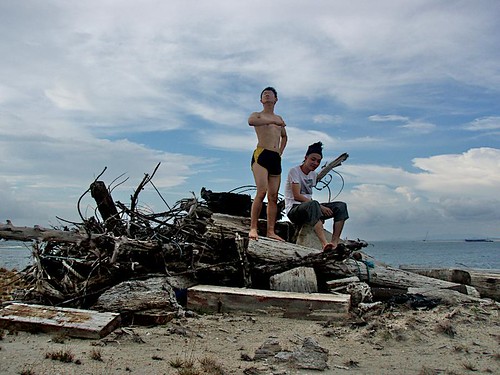
 At Documenta XI in 2002 he and Woon Tien Wei of Tsunamii.net (which also included Melvin Phua) walked 30 days from Kassel to Kiel where the Documenta Server was housed: theory at this time was chockfull of declarations that the Net is Flat, global interconnectivity = democracy, let the subaltern chat: Charles recognised this concept as inherently flawed because he kept getting knocked off Counterstrike for being a “high ping bastard”: players from the USA where every signal passes through the servers of the CIA could tell a thirdworldy slowed the game down: likewise, at Documenta, say a Bangladeshi video artist watching her own work on the website would have to pay to go thru the German server itself, back and forth, centre to periphery: why not physicalise this hegemony itself by walking to the site of the data, said Charles? 30 days of trudging from village to Teutonic village to get to the server farm: major bum rash, plus they missed the opening party.
Today Charles buses us to the Sentosa jetty, just off the country club ONEº15, boards us on a ship by good ol’ salt-haired Captain Blake who drifted here from New Zealand in 1965. Life saving drill: “quite hard to fall off if you’re sober,” Blake tells us: there are three bows he says on this trimaran (a word half Polynesian and half-Greek) so we can do the Leonardo di Caprio thing thrice over (David and Julie do), as long as we keep an eye out for icebergs.

We are on a 5-hour odysseyette (ideally it should have been have been 10, to circumnavigate the island) to discover a distant strip of reclaimed land: Charles brings maps and .wavs to demonstrate the changing shape of ourselves since 1819: bizarre outcroppings and conglomerations, Tuas, Sisters'-St John's Island, once we were a country of hills (compare Malaysian horizons) but we flattened the ground. And once we ran out of mountain we started to buy our sand; once they cut it off we kept buying under the table; come here weeknights he says and you'll see the clandestine barges, ferrying tons and tons of black market Indonesian sand.
On the way, we're scarpering across the deck, clad in shirtsleeves and speedos, lunching on 3-minute microwave otak-otak and white wine. When the yawling begins I climb to the wheel: Blake tells me how he only started commercial sailing this year: curses the corporate assholes who pay big money to party hardy on the boat to hip-hop when he wants Chopin; blesses the Edusave schoolkids whom he's licensed to take on 7-day peregrintations to the uninhabited islands of the South China Sea, lots of 'em, he says, where you can hike up a trail with a telescope and study astronomy with none of our lonely light pollution.

Eventually, we reach not the island but a promontory, an-insular-peninsula, a snaky reach of dumped sand that winds all the way back to the mainland. Illegal to dock here (HDB owns the land for chrissakes, though its identification as Singapore land is laughable yet legal) so we drop anchor and speedboat and swim.
 I have no pictures of the land itself. Brian popped into the water fishlike with his glasses on and I did likewise, forgetting that I swim like a stone: took all my stamina and presence of mind not to lose my 200-degree lenses in the briny deeps; hit the beach with the back of my head while backstroking for breath; bumbled over, scrabbled onshore where the girls were ouching at the shards of shell and coral beneath their barefeet: this is what you call a new beach, says Melati, who's seen them in Indonesia: the detritus hasn't had the time to grind itself fine into powder.
Of course I couldn't bring my camera, but others did: they will have the photograph of our raggletag ensemble poised on the bizarre mesa in the centre of the strip: Naeem's T-shirt hoisted on a length of driftwood IwoJimastyle: DEFEND BROOKLYN is our flag. Also images of my excursion with Charles and Chee Wai, walking steadily back to the mainland, encountering landbound creepers of purple labialike flowers, orange parasitic networks strangling the orphan tuffets, dogprints, abandoned tupperwares of kimchi, a barnacled Pokeball, a superior grade of sand Charles stuffs into a bottle, and a beautiful mound of hysterical driftwood that inspires us to re-enact the legend of Sindbad and the Old Man of the Sea (minus the bit where I defecate all over his face).
We are the last ones back: we change and hurry into the salon, where Charles delivers a lecture on his practice while Blake sails us back to Sentosa, rocking our poor seasick bellies like so many jellybeans in a pinata. We are an odd sodden lot:

Charles details his practice: from the rupture of SEA ME WEB 3 and the inaugural New Media Arts grant to his Sea Stories series, shooting buoys from an interior and exterior view of the island (and why all this value on land, he asks, given that historically it is the sea that the Orang Pulau Singapura lived on: fish prawns and trade while the land itself was inhospitable, untameably jungled, malign). SEA ME WEB 3, incidentally, was and is the Internet cable that connects Singapore to the States: every time a shark chomps it or an anchor rips it apart or a seismic seaquake pops its guts the Wonderful Worldwide Web gets chopped off, brutally. The Net is not flat, nosiree. Then reawakening to the reclamation projects: woohoo, wanna talk about Land Art? Move over, Robert Smithson: HDB does it for realz.
"People talk about their land, their soil, their blood. But in Singapore, land is just another commodity that can be traded."
-someone or other, forgot to take note
"Buy land. They're not making any more of it."
-Mark Twain
"You guys are really obsessed with that. Being part of the world map."
-Julie.
Xref. environmental impact of all this monkeying around: more land => smaller straits => higher, more dangerous currents, fishing habitats transformed, we used to be natural haven for dolphins and dugongs, you know? Julie takes this very personally, being a mermaid herself.
Also a screening of Charles and his wife Wee Li Lin's new silent film, Wrong Turn. Trust me, it's AWSUM.
 Roundtabled adjourned slept and docked. Read one of DJ Spooky's comics before he left. Went home to pack. Realised only when I collapsed into bed for a three-hour shuteye that Charles's warning had been right: after you've been on the sea, you get landsick: our bodies are attuned to naturally compensate for the motion, so afterwards stillness disorients us.
Which is why I've been feeling like shit lately. Better now. Ta.
UPDATE: Photos from Charles Lim: the island looks like that.
Subscribe to:
Posts (Atom)